

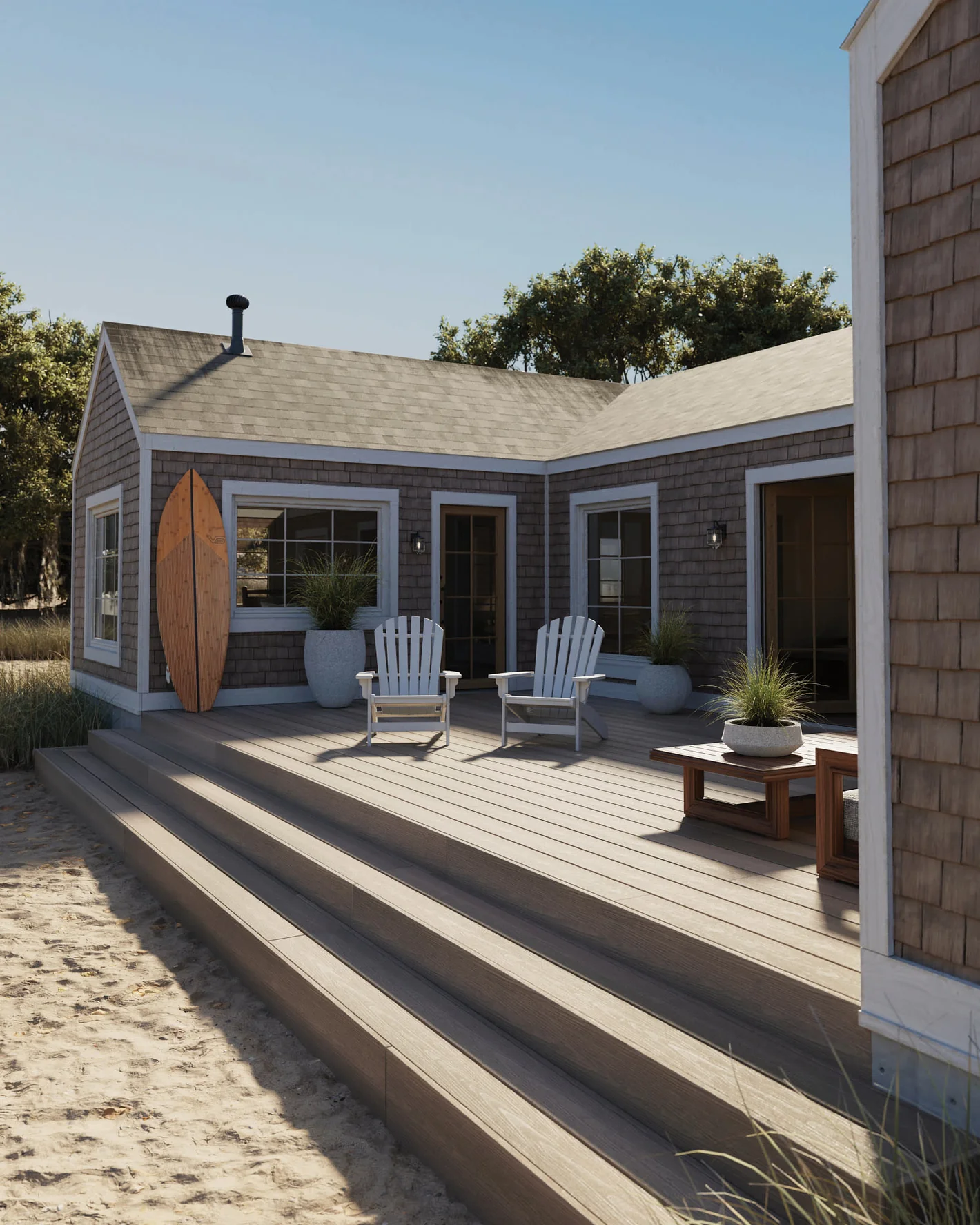
How to prepare solid concrete foundations for your composite deck
Technical note: Installation details vary by municipality, product line, board profile, fastening system, loads, and site conditions. Use this article as general guidance only; confirm the final design with your local building department, the manufacturer's current installation guide, and a qualified contractor or engineer when structural loads are involved.
As part of your outdoor landscaping in Quebec, preparing reliable concrete foundations is essential to ensure the durability and stability of your composite deck. Whether you choose Fiberon, TimberTech, Trex, or TruNorth deck boards, these high-end products require supports that comply with local standards and can withstand the harsh winters of La Belle Province.
Advantages of a composite deck in Quebec
Composite decks are gaining popularity in Quebec due to their resistance and low maintenance requirements. Here are some key benefits:
- Weather resistance: Composite boards do not crack, rot, or warp, even when exposed to extreme temperatures.
- Minimal maintenance: An annual wash with soapy water is sufficient, unlike wood, which requires sanding and staining.
- Durable aesthetics: Original colors, such as Walnut or Weathered Teak, retain their vibrancy for several years.
- Eco-responsible: Many manufacturers, including Trex and Fiberon, use recycled fibers to reduce environmental impact.
Types of foundations for decks and patios
Before pouring concrete, it is crucial to choose the appropriate support method for your project and your soil:
- Screw/helical piles: Installed by specialized contractors; suitability depends on soil, load, certification, and municipal acceptance.
- Helical piles: Mechanical solutions screwed into the ground; capacity must be verified for the soil and planned loads.
- Poured concrete foundations: Classic and robust when sized correctly, but diameter, depth, reinforcement, and mix must match local requirements and site conditions.
Choosing the right concrete strength
Concrete strength should be selected according to local code, exposure class, soil conditions, loads, and the approved plan. Many residential deck footings do not require 5,000 psi concrete, while heavier structures such as roofs, spas, or complex decks may require an engineered specification.
- Use the specified mix: follow the plan, engineer, municipality, or ready-mix supplier recommendation.
- Control water: excess water weakens concrete and increases cracking risk.
- Protect curing: cold weather and freeze-thaw exposure require proper curing and protection.
Step 1: Choosing the mix—pre-mixed bag or homemade formula
To simplify the process, many homeowners opt for ready-mix concrete bags. For more technical projects, a homemade mix remains an alternative:
- Pre-mixed bags: Available in 25 kg to 40 kg formats, they already contain all the components. Just add the indicated amount of water to obtain a homogeneous concrete.
- Specified mix: For structural footings, use a bagged or ready-mix product that meets the required strength and exposure class. Avoid improvised ratios unless they are specified by a qualified designer.
"Precision in ingredient dosage remains the secret to high-performing and durable concrete." - Civil Engineer, Université Laval
Step 2: Mixing techniques
Good concrete must have a fluid consistency to fill all voids, without being too liquid. To ensure perfect homogeneity:
- Wheelbarrow and pickaxe: Mix vigorously for 3 to 5 minutes to eliminate lumps.
- Concrete mixer: Renting a small concrete mixer reduces physical effort and obtains a uniform mixture in less time.
- Water control: Add water gradually. Excess water compromises final strength.
Step 3: Formwork and soil preparation
The success of the pour begins before the mix itself. Prepare the ground:
- Trench or drilling: Depending on your plan, dig or drill holes to the approved footing depth, generally below local frost depth for frost-protected footings; 40 cm is not enough for most elevated deck footings in Quebec.
- Formwork tube: Position rigid tubes or adjustable boards to delineate each pier.
- Vibrations: Before pouring, lightly tap the formwork to prevent air pockets from forming.
Step 4: Pouring and consolidation
For a professional result, pouring is done in several stages:
- First placement: Pour half of the concrete, then consolidate with a steel rod or a pickaxe to eliminate air pockets.
- Leveling: Add the rest of the concrete until it slightly overflows.
- Finishing: Scrape the surface with a metal ruler for a perfectly horizontal plane.
"Never underestimate the consolidation step: it ensures the internal cohesion of the concrete." - Construction Technician, Montreal
Step 5: Curing and frost protection
The curing period is crucial for developing the expected strength:
- Regular watering for 7 to 10 days to maintain the humidity necessary for hydration.
- Insulating tarp during cold nights to prevent premature freezing.
- No load on the foundations for at least 48 hours.
Regulatory aspects and budget planning
Before starting work, check with your municipality to avoid surprises:
- Building permit: Depending on the area and height of your deck, a permit may be required.
- Inspection: Several cities require an inspector's visit to validate the foundations before installing the deck boards.
Cost estimate
To help you budget for your composite deck or deck in Quebec project, here is a range for the main items:
- Concrete: confirm the local ready-mix or bagged concrete price for the strength and exposure class specified in your plan.
- Concrete mixer rental: $40 to $80 per day.
- Composite boards: $4 to $12 per linear foot depending on the brand (Fiberon, Trex, TimberTech, TruNorth).
- Fasteners and accessories: Approximately $1 to $1.5 per linear foot.
- Labor: $30 to $50 per hour if you hire a contractor.
Installation of Fiberon, TimberTech, Trex, and TruNorth boards
Once your concrete foundations are validated, you can proceed with installing the composite deck boards. Manufacturers offer fastening systems adapted to a stable base:
- Adjustable pedestals: Allow precise level adjustment, even on slightly uneven ground.
- Clipped systems: Developed by Trex and TimberTech, they simplify assembly and ensure optimal spacing.
- Stainless steel screws: Designed to resist corrosion and climatic variations.
Maintenance and longevity of your outdoor landscaping
Once your composite deck is installed, follow these best practices:
- Gentle cleaning: Use a mild detergent and a soft-bristled brush.
- Visual inspection: Check the condition of the boards and joints every spring.
- Preventive treatments: Apply a sun protective product if recommended by the manufacturer.
"A well-built foundation is the key to a durable and aesthetically pleasing composite deck." - Landscape Architect, Quebec
Conclusion and next steps
By following these detailed steps, you ensure robust concrete foundations and flawless installation of composite boards. Optimize your outdoor landscaping in Quebec and enjoy an aesthetic and durable deck in Quebec or composite deck for several years. Our experts at Magasin de Patio are at your disposal for personalized support and advice adapted to your land and your budget.