

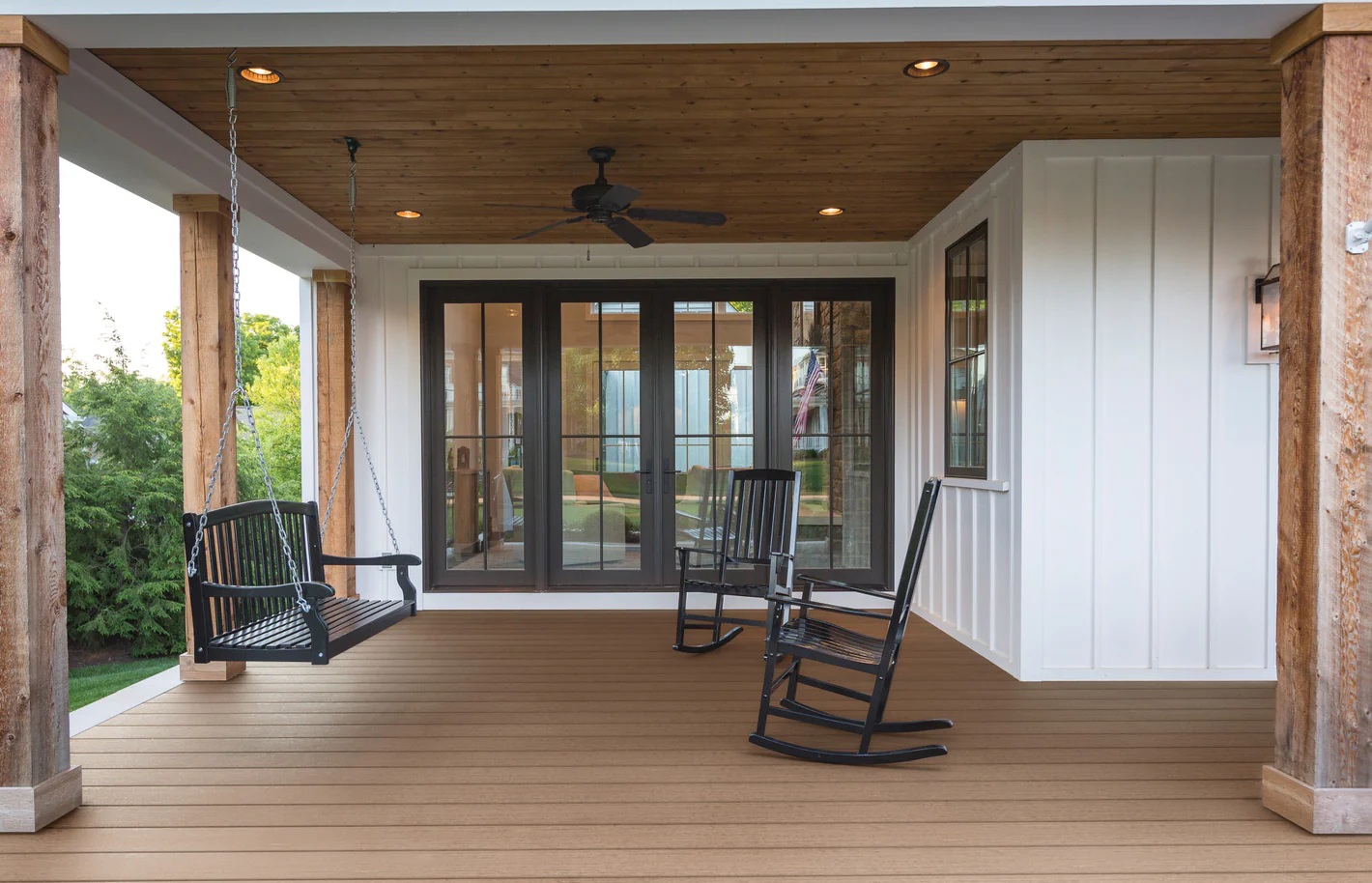
Choosing the best wood for your deck or patio
In Quebec, choosing the right material for your composite deck or wood deck is crucial. Between price, availability, and durability, you need to find the ideal balance. Here's a comparison of the most common wood species to guide you in your outdoor design, before discovering why a Fiberon, TimberTech, Trex, or TruNorth composite deck might be the most advantageous option.
Pressure-Treated
Pressure-treated wood is the most economical and common option for a standard deck. Generally, Southern yellow pine is used, to which a chemical preservative is added, injected under pressure into the wood fibers.
- Density: 14,400 psi
- Weight: 590 lbs.
- Elasticity: 5.2
Description & longevity
Its initial olive-green hue turns honey brown and then eventually greys. The majority of lumber yards in Quebec offer this material in 5/4 decking profiles. It is often guaranteed against rot and termites for the life of the original buyer.
Western Red Cedar
Western red cedar, prized for its natural aesthetic and rot resistance, is distinguished by its softer texture and fine grain.
- Density: 7,550 psi
- Weight: 455 lbs.
- Elasticity: 7.7
Description & longevity
Its shades range from light brown to salmon pink. Untreated, it first turns silvery grey then browns. Regular sealing is recommended to preserve its color and extend its durability.
Redwood
Redwood offers a unique natural beauty with its palette ranging from light red to dark reddish-brown. It is available in several grades, including the famous Clear Heart.
- Density: 9,800 psi
- Weight: 485 lbs.
- Elasticity: 9.2
Description & longevity
The Clear Heart grade is the most rot-resistant. This soft wood weathers very quickly to a yellowish-red tone, which may require frequent maintenance to retain its original hue.
Mahogany
True Honduran mahogany has a woven grain and a coarser texture than the tropical woods often sold under this name.
- Density: 11,900 psi
- Weight: 775 lbs.
- Elasticity: 11
Description & longevity
Only medium to dark red and brown mahoganies offer sufficient resistance for outdoor use. Other species referred to as "Philippine Mahogany" are not always suitable for decks exposed to the elements.
Why choose a composite deck?
Traditional woods require regular maintenance (sealing, sanding, insect treatment) and can discolor or crack. In comparison, composite decks are designed to resist mold, stains, and UV without intensive maintenance.
- Fiberon: Allows for a natural look and a wide range of colors, including Weathered Teak or Ironwood finishes.
- TimberTech: Offers anti-slip profiles and scratch-resistant technologies.
- Trex: Market leader, offers high-end ranges with full capping for optimal protection.
- TruNorth: Canadian specialist, adapted to our climate, with a durable core and reinforced edges.
"Composite decks offer exceptional durability without compromising on natural appearance." - Paul Tremblay, outdoor design expert
Conclusion
Whether you prefer the authentic charm of Pressure-Treated, Western Red Cedar, Redwood, or Mahogany wood, composite decking remains a durable, low-maintenance, and ideal solution for Quebec's climate. Transform your deck into an outdoor living space with worry-free maintenance and a modern style.