

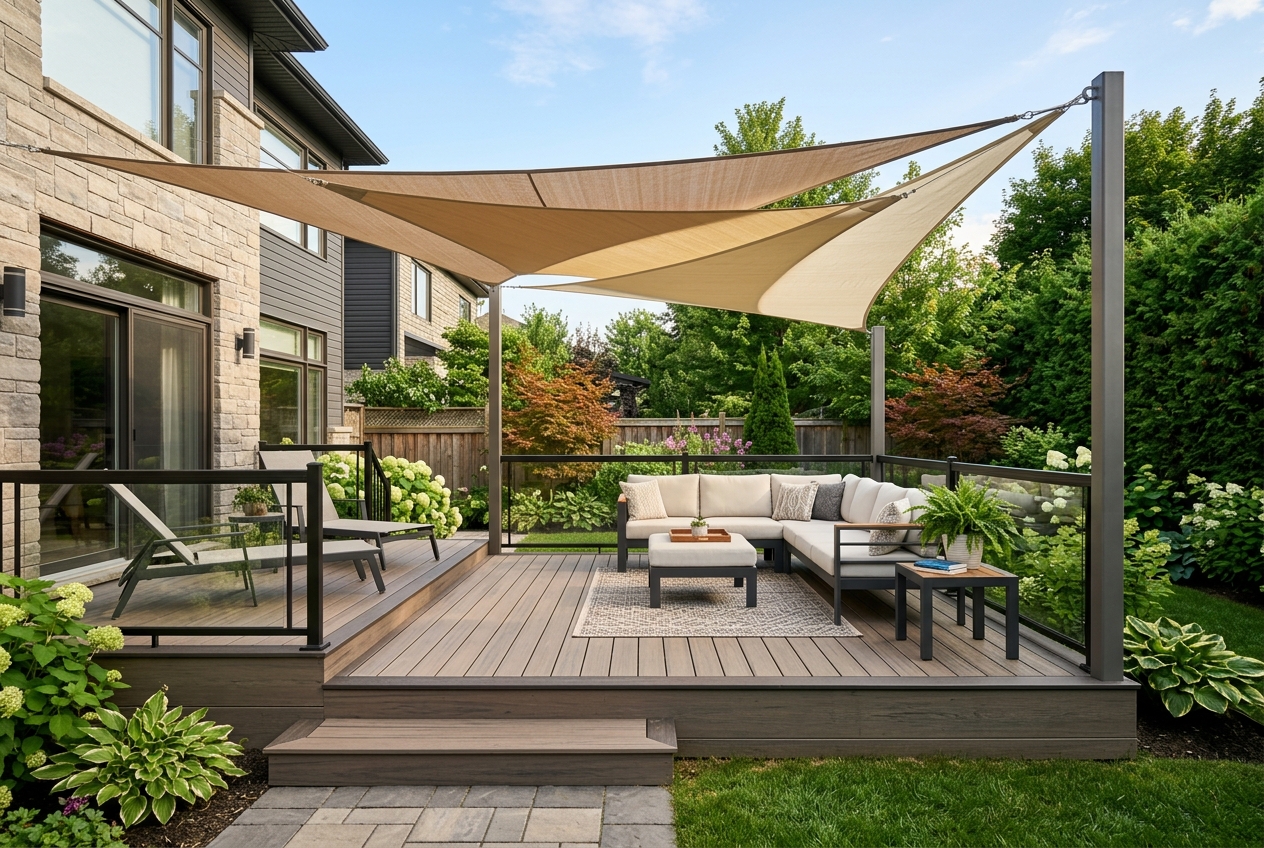
Shade Sail Installation Guide: Blocking the Afternoon Sun on Your Composite Deck in Quebec
Summer in Quebec is a beautiful and highly anticipated season, but when the months of July and August bring their stifling heatwaves, your backyard can quickly turn into a real furnace. The afternoon sun, particularly blazing and blinding, often beats directly down on your outdoor living space, sometimes making it difficult to relax, read a book, or entertain guests comfortably. For those who choose to spend their staycations at home or simply love to unwind on their patio after a long day at work, finding an effective, durable, and aesthetically pleasing shade solution becomes an absolute priority to enjoy the beautiful season.
While traditional patio umbrellas blow away at the slightest gust of wind and massive pergolas require major work, municipal permits, and a substantial budget, tensioned shade sails stand out as a precise and resolutely modern architectural alternative. This comprehensive guide focuses exclusively on the art of choosing, designing, and safely anchoring these elegant canvases above your space. By mastering tilt angles and layering techniques, you will be able to effectively block the oblique late-day rays, all while enhancing the design of your outdoor landscaping and protecting your investment.
The Strategic Importance of Shade in the Middle of a Quebec Summer
Summer heatwaves in Quebec are unforgiving, especially during the critical time frame between 2 PM and 6 PM. Creating a generous and well-thought-out shaded area on your patio is essential to maximize the use of your outdoor space throughout the day. Well-planned shade not only allows you to reduce the perceived ambient temperature by several degrees but also creates a pleasant microclimate for your summer evenings, family dinners, and moments of relaxation. It is truly the key element that transforms a simple backyard exposed to the elements into a true staycation oasis, inviting prolonged relaxation.
Protecting and Cooling Your Composite Investment
High-quality composite boards are designed to last for decades with minimal maintenance, but like any dense material exposed to direct sunlight, they can absorb a significant amount of heat. Whether you have opted for reputable market brands like Fiberon, TimberTech, Trex or TruNorth, adding a shade sail ensures that the surface of your deck remains temperate and comfortable under the bare feet of your children, guests, or pets. By blocking the intense afternoon UV rays, you ensure immediate thermal comfort while highlighting the beauty of the wood grains and the rich colours of your composite deck, without the discomfort of radiant heat.
What is a Tensioned Shade Sail?
Directly inspired by maritime technology and textile architecture, a shade sail is a robust canvas, generally made of woven high-density polyethylene (HDPE), designed to be stretched firmly between several solid anchor points. Unlike a simple retractable awning or a temperamental umbrella, a tensioned sail does not flap in the wind if it is properly installed with adequate tension. It offers structural integrity that creates clean, geometric, and contemporary lines, blending perfectly with the modern, transitional, and even classic architectures of Quebec homes.
The Architectural Advantages Over Pergolas and Umbrellas
Shade sails offer unmatched design flexibility and visual lightness in the landscaping market.
- Airy Aesthetics: They do not clutter the floor of your composite deck with heavy and bulky bases like cantilever umbrellas do, thereby freeing up valuable space for circulation.
- Visual Lightness: Much less massive and imposing than a wooden or aluminum pergola, they preserve the feeling of open space and do not completely block the view of the sky or your garden.
- Unlimited Customization: The shapes, vibrant or neutral colours, as well as the mounting heights can be custom-adjusted to perfectly fit the unique configuration of your patio.
Evaluating the Trajectory of the Afternoon Sun in Quebec
To effectively block the sun with a sail, you must first understand and anticipate its summer path. In Quebec, during the hot months of July and August, the late-day sun slowly descends towards the west and southwest. It is these oblique, almost horizontal rays that are the most blinding and uncomfortable. Even before buying your canvas, take the time to observe how the natural shade moves across your composite deck between 3 PM and 7 PM. It is this specific and relentless trajectory that will dictate the strategic placement of your anchor points and the necessary tilt angle of the sail.
Choosing the Ideal Shape: Triangle, Square, or Rectangle?
The geometric shape of the sail not only determines the projected shade area but also greatly influences the overall visual style of your outdoor layout.
- The Triangle: This is the perfect shape for tight corners and for creating a dynamic visual effect. Although it offers less total shade in square metres, it allows for bold and airy designs.
- The Square or Rectangle: The ideal choice for covering large uniform areas, such as a vast dining area, an outdoor kitchen, or a complete large patio lounge.
- The Combination of Shapes: The professional approach consists of using several different geometric shapes to cover an irregular area while adding an undeniable artistic touch.
The Art of Layering for a Spectacular Design
Layering multiple shade sails is the best-kept secret of professional designers to maximize shade coverage while creating a striking three-dimensional visual impact. Instead of using a single huge canvas that could look heavy, sag in the centre, and be very vulnerable to high winds, use two or three smaller sails that partially overlap. By skillfully playing with complementary colours and different anchor heights, you will achieve optimal protection against the afternoon sun while allowing hot air to naturally escape between the layers of fabric.
Calculating Strategic Tilt Angles
A golden rule in landscaping: a shade sail should never be installed perfectly flat. The tilt, creating a hyperbolic twist, is crucial for two major reasons. First, it allows rainwater to run off quickly, thereby preventing the formation of heavy water pockets that could irreversibly stretch or tear the canvas. Second, by significantly lowering one of the corners on the west or southwest side of your deck, you create a true physical barrier against the low rays of the late afternoon sun, ensuring cool and constant shade for your guests at cocktail hour.
Permeable vs. Waterproof Fabric: What to Choose?
On the current market, you will mainly find two broad categories of fabrics, each with its own requirements. Permeable sails (often made of HDPE) block up to 95% of harmful UV rays while letting a light, refreshing breeze and rainwater pass through. This is by far the most popular, coolest, and safest choice in Quebec to withstand summer gusts. Waterproof sails (made of PVC or coated polyester), on the other hand, protect against rain but require a much steeper slope (at least a 20% to 30% incline) and extremely robust anchors to resist the lifting force of the wind, as they act like true closed parachutes.
Tension Hardware: The Importance of Stainless Steel
The aesthetic success and durability of a residential installation lie in the tension, and for this, you absolutely need marine-grade hardware.
- Turnbuckles: These are indispensable mechanisms for adjusting the final tension with great precision, allowing the canvas to remain perfectly straight.
- Carabiners and Shackles: They allow the sail to be removed quickly and easily in the event of a severe storm warning or as winter approaches.
- 316 Stainless Steel: In Quebec, with summer humidity, frequent rains, and harsh weather, marine-grade stainless steel is mandatory to prevent rust that could drip and irreversibly stain your beautiful composite deck.
Planning Anchor Points with Precision
A well-tensioned shade sail exerts enormous traction (often several hundred pounds of continuous force) on its anchor points, particularly under the effect of the wind. It is therefore imperative to choose extremely solid load-bearing structures. The exterior walls of the house, massive roof rafters, or posts specially erected for this purpose are the standard and safe options. Absolutely never attach a sail to the gutter, decorative aluminum fascia, or a small tree; the force of the wind would tear off these fragile elements in no time, causing very costly damage to your property.
Installing Independent Support Posts
If the configuration of your house does not provide enough ideally located anchor points, you will need to install freestanding posts. In Quebec, the deep winter frost imposes strict building rules.
- Deep Foundations: Concrete bases (sonotubes) must absolutely go below the frost line (generally 4 feet or 1.2 metres deep) to prevent heaving.
- Choice of Material: Galvanized steel posts of 4 inches in diameter or solid wood posts (6x6 minimum) are highly recommended to resist bending.
- Tilt Angle: It is often clever to slightly tilt the post (by about 5 to 10 degrees) in the opposite direction of the sail's traction to counteract the permanent tension force.
Safe Attachment to the House Structure
When you choose to anchor directly to the house, you must absolutely go through the exterior siding (vinyl, CanExel, brick) to reach the solid wood structure (wall studs, solid structural brick, or rim joist). Use robust pad eyes secured with long and thick lag screws. It is of paramount importance to apply a high-quality exterior silicone sealant around the drill holes to prevent rainwater from seeping into the walls of your residence, which would cause invisible rot over the seasons.
Installation and Tensioning Steps
The physical installation is done in several methodical steps to guarantee a professional result. Start by laying the sail neatly on your composite deck to visualize the exact location and the direction of the seams. Measure the distance between the corners of the sail and your anchor points; you must leave about 10% of the total length of the sail free to insert the tension hardware. First, attach the opposite corners with simple carabiners without turnbuckles, then use the turnbuckles opened to the maximum on the last corners to apply the necessary traction force. The final canvas must be stretched like a drum skin, without any visible wrinkles or flapping.
Integrating Lighting for Your Summer Evenings
Once the sun finally sets, your patio transforms into an enchanting nighttime entertaining space. Shade sails offer an excellent aerial structure for hanging bistro-style string lights. By delicately attaching the lights along the steel tension cables or on the perimeter of the canvas (never directly sewn onto the stretched fabric to avoid friction wear), you create a magical, warm, and inviting atmosphere. It is the perfect lighting solution to prolong your summer evenings well after nightfall, while highlighting the architecture of your installation.
Protecting Your Patio Plants and Landscaping
Container gardening is extremely popular on modern decks, but the blazing full sun of July can quickly dry out and burn delicate foliage. The soft, filtered shade of a permeable sail creates an ideal growing environment for many tropical plants, hostas, and ferns that decorate your patio. By strategically positioning your shade sail, you protect your precious plants from extreme desiccation while providing them with the indirect light they desperately need to thrive and stay green throughout your staycation.
Summer Maintenance and Preparation for the Quebec Winter
Regular maintenance of a quality shade sail is fortunately relatively simple. An occasional cleaning with a gentle stream of water and a neutral soap (without abrasive detergent) is more than enough to remove accumulated dust, pollen, and bird droppings. However, the harsh Quebec climate requires special vigilance when autumn arrives. Shade sails are absolutely not designed to support the crushing weight of snow or violent ice storms. At the end of the beautiful season, generally in mid-October, it is imperative to loosen the turnbuckles, detach the sails, clean them, dry them completely in the open air, and store them indoors for the winter.
Common Mistakes to Avoid During Installation
Despite the apparent simplicity of the concept, many homeowners make technical mistakes that reduce the lifespan of their installation and its effectiveness.
- Lack of Adequate Tension: A loose sail will flap violently in the wind, which prematurely wears out the fabric fibres and fatigues the anchoring hardware.
- Undersized Anchors: Underestimating the phenomenal force of the wind on a large canvas surface is the most frequent and costly mistake.
- Ignoring the Actual Sun Trajectory: Installing the sail too high or perfectly flat will unfortunately not block the low and blinding 5 PM sun, making the installation practically useless at the exact moment you need it most.
Maximizing the Comfort of Your Staycation
By investing time and resources into a thoughtful, aesthetic, and safe shade sail installation, you completely redefine the living experience in your backyard. Your composite deck instantly becomes a true seamless extension of your home, a shaded and sophisticated sanctuary where it is a joy to live, read, eat, and gather with family, even on the most overwhelming days of the Quebec summer. It is the ultimate architectural touch for a successful staycation, combining magazine-worthy contemporary design with absolute thermal comfort for you and your guests.