

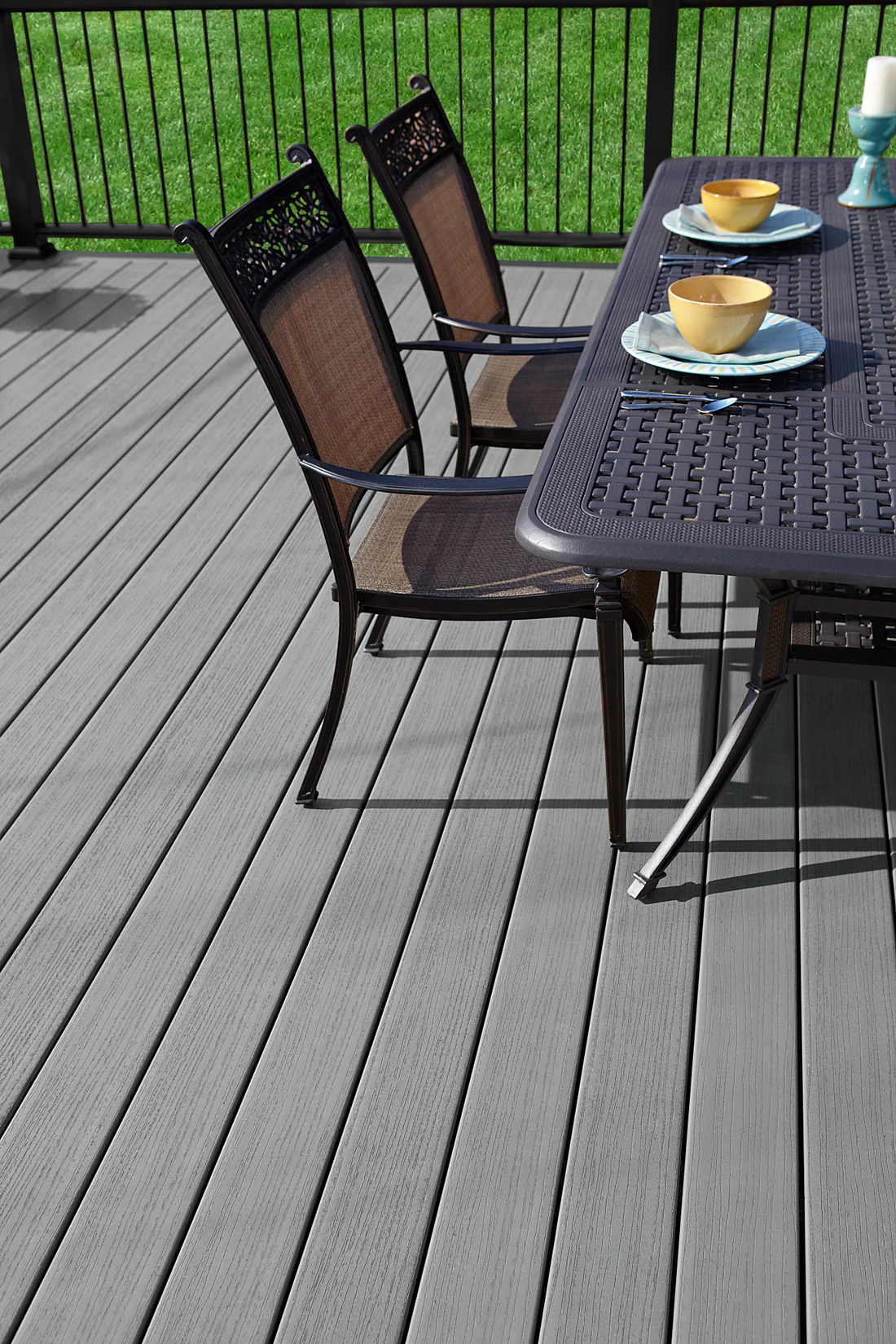
Assessing a hollow block foundation before anchoring a composite deck
Technical note: Installation details vary by municipality, product line, board profile, fastening system, loads, and site conditions. Use this article as general guidance only; confirm the final design with your local building department, the manufacturer's current installation guide, and a qualified contractor or engineer when structural loads are involved.
Installing a composite deck in Quebec sometimes involves an existing hollow block (CMU) wall. Treat this as a structural warning sign, not a simple fastening detail. A hollow CMU wall is not automatically suitable for a deck ledger; in many cases a freestanding deck or an engineered connection is the safer solution.
Before considering anchors in hollow blocks
Do not select anchors by rule of thumb. Any connection to hollow CMU should be verified by an engineer, the anchor manufacturer's technical data, and the local building official. If an engineered detail is accepted, the fasteners must:
- Comply with manufacturer's instructions: Each anchoring product (epoxy, resin, or other adhesive) comes with a strict installation guide.
- Offer corrosion protection: Fasteners must be approved for outdoor and damp environments.
- Account for the full load path: pull-out, shear, edge distance, grout, reinforcement, wall condition, and moisture must all be verified.
"The key to a durable fastening is to strictly follow the manufacturer's instructions and use an adequate number of anchor points for the loads." - Outdoor Construction Expert
Hollow block vs. solid concrete: understanding the differences
Hollow blocks (CMU) generally have lower pull-out strength than solid concrete. To compensate:
- Do not simply add more fasteners: spacing, edge distance, CMU cell condition, grout, reinforcement, and the load path must be verified.
- Check wall uniformity: Voids must be filled as recommended if necessary.
Waterproofing and drainage around the deck board
Protecting the joint between the deck board and the wall is essential to prevent water infiltration. Plan for:
- Waterproof membrane: Install caulking compatible with composite material.
- Ventilated joint: Leave an expansion gap to promote moisture evacuation.
- Finishing profiles: Choose accessories suitable for Fiberon, TimberTech, Trex, or TruNorth decking.
Maintenance of fasteners and structure
After installation:
- Regular inspection: Check the condition of epoxy anchors and replace them if apparent corrosion.
- Cleaning: Clear debris around anchor points to maintain performance.
- Rebalancing: Adjust fasteners if movements are detected.
Standards and regulations in Quebec
In Quebec, deck construction requires validating the applicable code version, municipal requirements, and anchor data sheets:
- Anchoring depth: consistent with the anchor data sheet, wall type, and approved plan.
- Distancing: Respect for minimum distances between the deck and the neighboring property.
- Permits and inspections: Obtain necessary authorizations before work.
Choosing materials for your composite deck
Successful installation also depends on the choice of decking boards:
- Fiberon: High moisture resistance, wide range of colors.
- TimberTech: Advanced technologies to prevent fading and scratches.
- Trex: Recycled materials, minimal maintenance.
- TruNorth: Economical solution, solid performance.
Case study: A composite deck in Quebec
Recently, a client in Quebec contacted Magasin de Patio to install a TimberTech composite deck on a hollow block foundation. Thanks to:
- Selection of epoxy anchors: Certified product for outdoor wet use.
- Partial filling of cavities: Improved bearing capacity.
- Careful installation of the deck board: Adherence to drilling distances and setting time.
The safer outcome is a connection method that has been reviewed before installation, or a freestanding structure that avoids relying on the hollow block wall for deck loads.
Final tips for a successful outdoor space
To perfect your deck or composite deck:
- Plan for ventilation: Leave enough space under the boards to prevent moisture accumulation.
- Choose appropriate lighting: Opt for recessed lighting compatible with composite material.
- Consider a warranty: Check the warranties offered by Fiberon, TimberTech, Trex, or TruNorth.
Conclusion
Whatever your choice, whether an engineered connection is possible or a self-supporting structure is the safer choice, the success of your outdoor living project in Quebec relies on following proper anchoring practices. For personalized support and to ensure the longevity of your deck, contact Magasin de Patio.
Ready to bring your composite deck project to life?
Contact us for a personalized assessment and benefit from expert advice tailored to your foundation.