

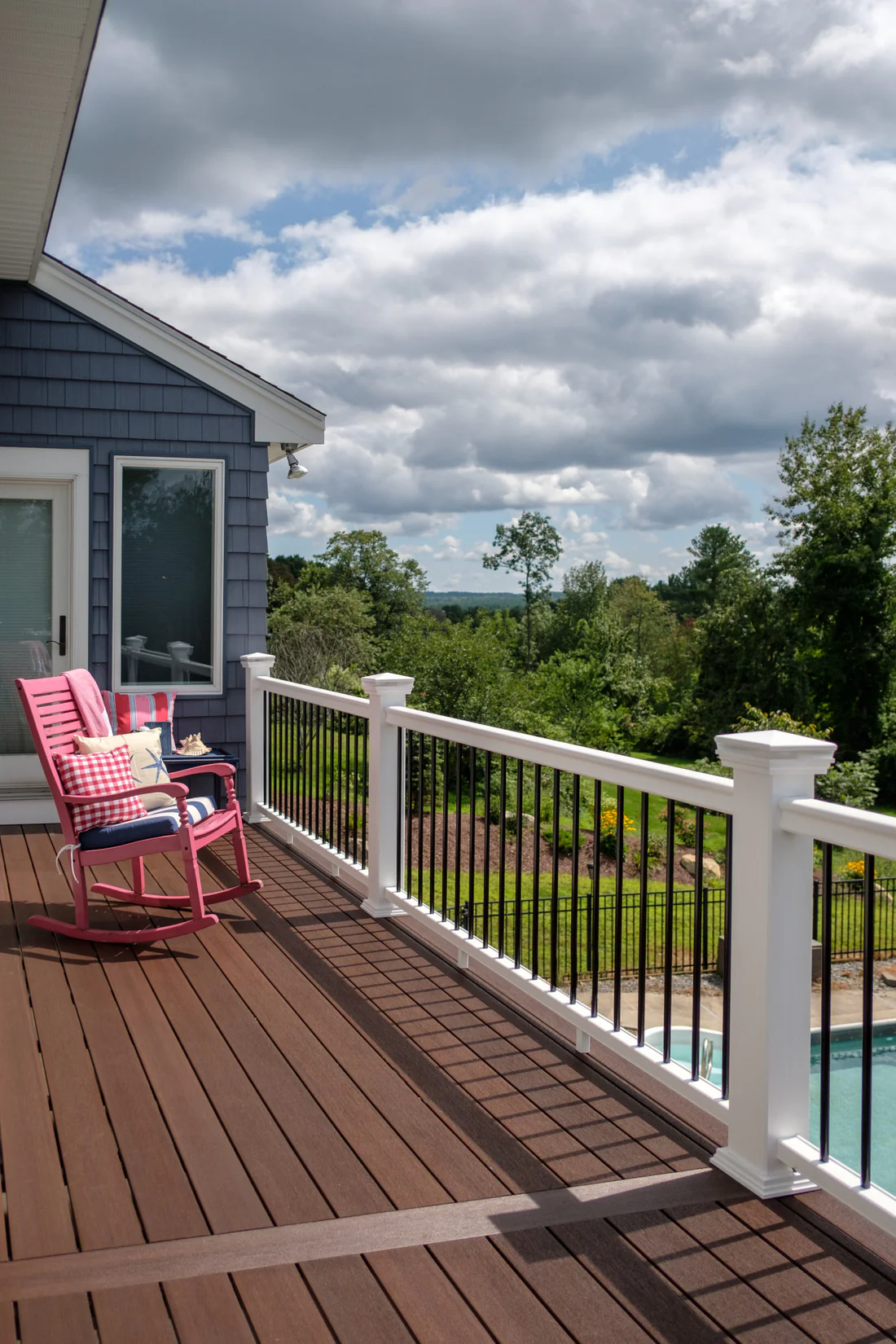
Optimizing Your Stairs for a Composite Deck
Technical note: Installation details vary by municipality, product line, board profile, fastening system, loads, and site conditions. Use this article as general guidance only; confirm the final design with your local building department, the manufacturer's current installation guide, and a qualified contractor or engineer when structural loads are involved.
When it comes to outdoor landscaping for a deck in Quebec, stair construction is often cited by professionals as the most delicate aspect. Indeed, precision in the design and installation of stair stringers determines not only the aesthetics but, more importantly, the safety and durability of your composite deck. Whether you're working with Fiberon, TimberTech, Trex, or TruNorth boards, this guide will walk you through the steps to successfully build your stairs.
1. Measure the Height and Determine the Number of Steps
The first step is to measure the "total rise": the vertical distance between the top of the decking and the final location of the stairs on your property. Use a level and a tape measure to get the exact height.
Then, enter this value into our composite deck stair calculator. It will provide you with:
- The number of steps: based on the total rise and the riser height accepted by your municipality.
- The height of each riser: selected for comfort and validated against local requirements.
- The depth of each tread: generally 9" to 11" to ensure a natural stride.
Note that you should always subtract the thickness of the "riser board" from the first step and the thickness of the "tread board" from the last step.
2. Mark and Cut Notches on Your Stringers
Choose 2x12 stringers to solidly support the steps. Transfer your "rise" and "run" measurements onto the piece using a carpenter's square:
- First, trace the profile: place the square at one end and mark the "rise" (riser) and "run" (tread).
- Move the square: repeat the operation for each step, maintaining perfect linearity.
- Add 1" setback: at the back of the stringer for the 1" riser board (if installing a standard riser).
- Subtract 1" from the last notch for the 1" bottom tread board.
Then, cut with your circular saw along the line. Lightly file the angles to avoid any stress points on the composite.
3. Stringer Spacing and Structural Support
The distribution of stringers ensures the strength and longevity of your steps. Follow these principles:
- Standard spacing: do not assume 16" O.C. for composite stair treads. Follow the selected manufacturer's stair-span table; many profiles require closer support.
- Stair width: install at least four stringers for any run exceeding 36" (91 cm).
- Composite or 5/4 wood: some materials require reduced spacing of 10" on center to prevent flexing.
- Corner and offset: if your stairs turn around a corner or have a cascading run, precisely calculate the placement for each stringer.
Oversizing your stringers is often preferable to compensate for increased wear and tear due to heavy foot traffic on the stairs.
"Stairs are subjected to stronger dynamic loads than the rest of a deck. Too wide spacing can compromise safety and accelerate wear." - Jean Tremblay, composite deck expert
4. Choosing Your Composite Material
For a composite deck in Quebec's climate, opt for boards resistant to freeze-thaw cycles and humidity:
- Fiberon: non-slip and durable, ideal for outdoor stairs.
- TimberTech: very realistic wood texture and increased UV resistance.
- Trex: wide range of colors such as Spiced Rum or Havana Gold, perfect for a contemporary look.
- TruNorth: high-performance range, less maintenance, and excellent dimensional stability.
These brands offer long-term warranties, often between 25 and 50 years, for your steps and composite deck.
5. Compliance and Local Requirements
Before starting work, ensure you comply with local standards:
- Riser height: confirm the allowed maximum with the municipality and keep all risers uniform.
- Tread depth: confirm the required depth with local code and the selected board system; many composite deck details use two boards to provide about 10" to 11" of depth.
- Guard: confirm the fall-height threshold, height, openings, and required loads with your municipality.
- Non-slip coating: recommended for composite tread boards to prevent accidents.
Consult your municipality to obtain the required permits and validate your plans before installation.
6. Maintenance and Durability
To preserve the new appearance of your stairs:
- Regular cleaning: soapy water and a soft brush at least twice a year.
- Avoid harsh chemicals: prefer mild detergents compatible with composite.
- Fastener inspection: check screws and supports in spring and fall.
- Anti-freeze protection: do not use salt or abrasives, prefer chloride-free de-icers.
Adequate maintenance extends the life of your composite deck and stairs.
Conclusion: Strong and Aesthetic Stairs for Your Patio
The success of your composite deck stairs relies on precise measurements, rigorous calculations, and a wise choice of materials. By following these steps and relying on brands like Fiberon, TimberTech, Trex, or TruNorth, you will achieve an outdoor living space that is safe, durable, and harmonious.
Ready to Transform Your Deck in Quebec Project?
Contact our specialists for a free estimate and benefit from personalized advice for your stairs and composite deck.