

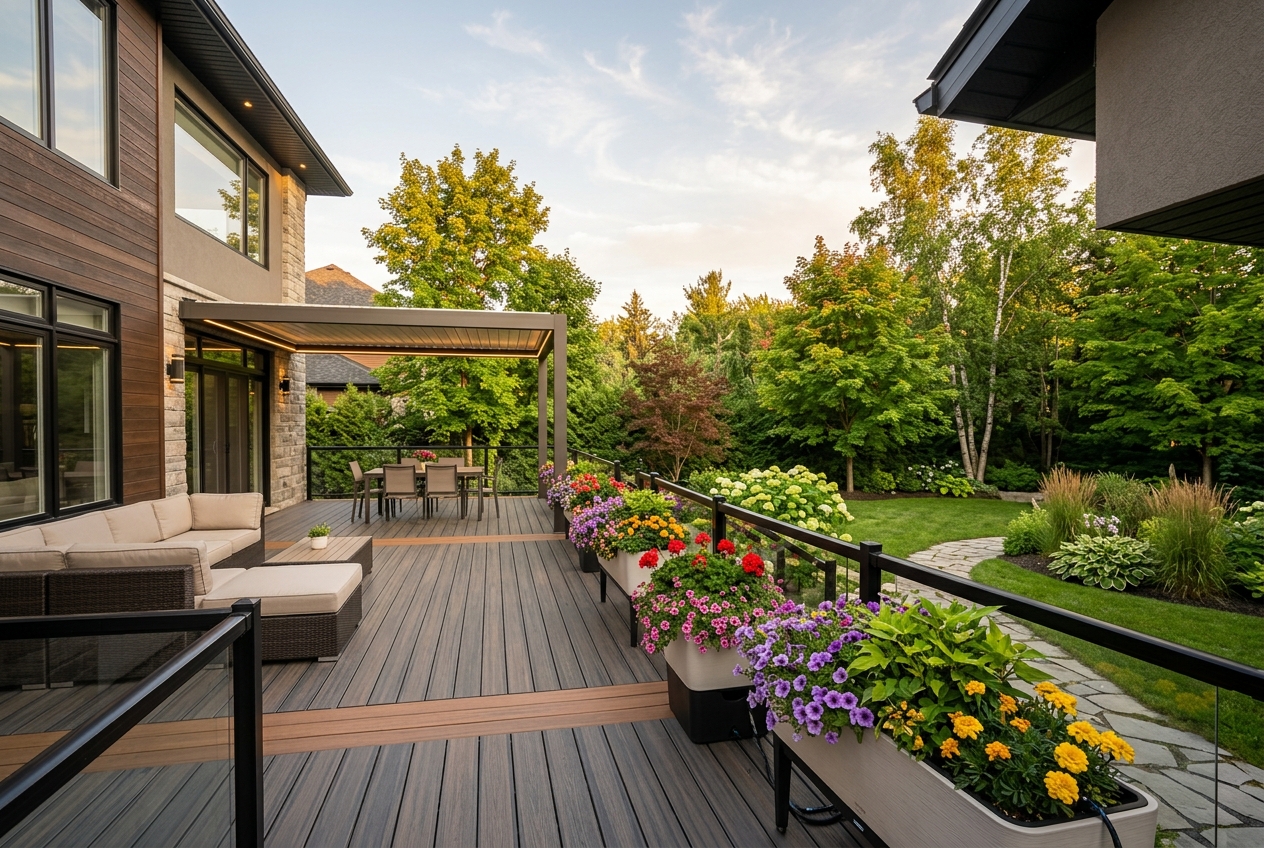
Self-watering planters: the solution to preserve your patio plants during heatwaves and your summer vacations in Quebec
Summer in Quebec is a beautiful season, but it often brings its share of weather challenges, notably the famous July and August heatwaves. When the mercury climbs above 30 degrees Celsius and the sun beats down on your outdoor landscaping, your potted plants are the first to suffer from water stress. The rapid drying of the potting soil can turn your green oasis into a sad sight in just a few hours. This is where self-watering technology comes into play to save your landscaping and preserve the beauty of your backyard.
Unlike traditional pots that require daily vigilance, self-watering planters offer remarkable autonomy. Whether you are planning to go on vacation for two weeks in the Maritimes, escape to the cottage during the construction holiday, or simply want to enjoy your summer evenings on your patio without the chore of the garden hose, these smart containers are the key. In this article, we will explore in depth how these bins work, why they are essential for your landscaping, and how they perfectly integrate into your Quebec summer lifestyle.
The challenge of Quebec heatwaves for your potted plants
The months of July and August in Quebec are often marked by periods of extreme heat and high humidity. On a deck exposed to full sun, water evaporation in traditional pots is lightning fast. The roots of your annuals and perennials quickly find themselves dry, causing often irreversible wilting. Self-watering planters counter this phenomenon by providing a constant supply of moisture from the base, thus imitating the natural cycle of groundwater. Your plants can therefore continue to thrive despite the overwhelming temperatures.
What is a self-watering planter and how does it work?
A self-watering planter is composed of two distinct sections: the planting area where the potting soil is located, and a water reservoir located at the bottom of the container. The two are separated by a grid or a false bottom. The water travels up to the roots by capillary action, often through fabric wicks or soil columns that soak directly in the water.
- The reservoir: Stores a large amount of water, enough for several days or weeks.
- The separation: Prevents the roots from rotting by not letting them stagnate directly in the water.
- The fill tube: Allows you to add water directly into the reservoir without wetting the foliage, thus reducing fungal diseases.
The major advantage: going on vacation with peace of mind
One of the biggest dilemmas for amateur gardeners is leaving home during vacations or a long weekend. Asking a neighbor or family to come and water is a solution, but it is not always reliable or practical. With a well-filled self-watering bin, your plants can survive for one to three weeks without any human intervention, depending on the size of the reservoir and the weather conditions. You can thus head to the cottage or on a trip knowing that your horticultural investment will still be flourishing upon your return.
Protecting your investment: ideal for a composite deck
If you have invested in a beautiful outdoor structure, you know it is crucial to preserve it. Traditional pots with drainage holes at the bottom often leak muddy water that can permanently stain the surface of your patio. Self-watering systems are generally closed or have a controlled lateral overflow. This means there is no constant flow of dirty water onto your superb Fiberon, TimberTech, Trex or TruNorth boards. Your deck remains clean, safe, and aesthetically flawless throughout the summer season.
Planter materials suited to the Quebec summer climate
When shopping for your self-watering bins, the choice of material is paramount. Since Quebec summers are very hot, you must avoid materials that absorb too much heat, like dark metal, which could boil the water in the reservoir and damage the root system. Opt for high-quality, UV-resistant plastics, or woven resins that imitate rattan. Fiberglass is also an excellent option as it offers good thermal insulation, thus protecting the roots and the water reserve from extreme temperature variations.
How to properly prepare the bottom of your self-watering bin
Although the system is designed to be autonomous, proper preparation is the key to success. Before adding your potting soil, make sure the capillary columns or wicks are securely in place. Unlike regular pots, you must absolutely not put gravel, rocks, or clay pebbles at the bottom of the planting area, as this would block the capillary process. The potting soil must be in direct contact with the water via the designated areas so that moisture can effectively travel up to the roots.
The right potting soil: the secret to optimal capillarity
Not all potting soils are created equal when it comes to self-watering planters. It is imperative to use a light and porous mix, specifically formulated for containers.
- Peat moss: Excellent for retaining moisture and lightening the mix.
- Perlite or vermiculite: Ensures good aeration to prevent soil compaction over the summer.
- Coco coir: An eco-friendly addition that promotes exceptional capillarity, drawing water from the reservoir upwards evenly.
Selection of perfect plants for the full July sun
On a south-facing deck, the heat can be intense, especially in the middle of July. Fortunately, the self-watering system allows you to grow water-hungry plants that would not otherwise survive in a standard pot. Petunias, geraniums, lantanas, and calibrachoas are spectacular choices that will bloom abundantly if their roots have constant access to water. You can also grow summer vegetables like cherry tomatoes or peppers, which require very regular moisture to prevent blossom end rot.
Varieties for shade and relaxation areas
If your backyard is lined with mature trees or if you have a pergola offering soothing shade for your summer gatherings, self-watering planters are just as useful. They drastically reduce the watering frequency for shade plants that like cool but not soggy soil.
- Begonias: Offer vibrant colours without requiring full sun.
- Coleus: Their spectacular foliage thrives with constant moisture.
- Ferns: Ideal for creating a tropical and relaxing atmosphere near your reading nook.
Initial watering: a crucial step often forgotten
A common mistake when using these bins is to only fill the reservoir at planting. The roots of young plants coming from the nursery are not yet long enough to benefit from the water located at the bottom of the bin. For the first two to three weeks, you must water the surface of the potting soil traditionally. This allows the roots to establish themselves and grow vigorously down towards the moisture source. Once you notice that the reservoir's water level begins to drop on its own, you know the capillary system is 100% functional.
The water level indicator: your best friend of the summer
The majority of quality models are equipped with a water level indicator. This small red or yellow float moves up and down in a transparent tube to tell you exactly how much water is left at the bottom. It is an indispensable tool to avoid overwatering, which is just as damaging as a lack of water. During the intense heat of August, get into the habit of checking this indicator once or twice a week. If it shows the maximum, do not add anything. If it nears the minimum, it is time to use your hose to fill the reservoir.
Summer fertilization in a self-watering system
Bottom watering changes the way you should fertilize your plants on your patio. If you pour liquid fertilizer directly onto the potting soil from above, it risks being washed into the reservoir and accumulating there, creating a toxic concentration for the roots. The best approach is to use slow-release fertilizers (in granules) mixed into the potting soil during spring planting. Alternatively, you can dilute a very low dose of liquid fertilizer directly into the water of the fill tube, thus ensuring constant nutrition throughout the summer.
Preventing water overheating in the reservoir
In the middle of summer, the sun beating directly on the walls of a pot can cause the water temperature inside the reservoir to climb. Water that is too hot can literally cook the roots of your plants and promote the development of bacteria. To avoid this, place your planters so that the container itself is slightly shaded by patio furniture, while leaving the foliage in the sun. Furthermore, opt for light-coloured bins that reflect the rays instead of absorbing them.
Aesthetics: matching your pots with your patio
The landscaping of your backyard should be a harmonious extension of your home's architecture. Fortunately, manufacturers of self-watering planters now offer ultra-modern designs that pair perfectly with high-end building materials. Whether you have opted for the rich, textured shades of Fiberon, TimberTech, Trex or TruNorth, you will find pots with matte, ribbed, or smooth finishes that will complement your decor. The integration of colours between your composite deck and your containers creates an outdoor living space worthy of the most beautiful magazines.
Entertaining guests: creating a lush atmosphere for your evenings
Summer in Quebec is synonymous with barbecues with friends and long evenings spent chatting under the stars. Plants play a key role in making your space inviting and warm. By using self-watering bins, you ensure that your floral arrangements will always be impeccable, without wilted leaves or dried-out potting soil, even if you forgot to water them that very morning. You can use large rectangular planters to create natural partitions, thus delineating the dining area from the relaxation zone.
Staycation: maximizing relaxation
Sometimes, the best vacations are the ones spent in your own backyard. The concept of a "staycation" takes on its full meaning when your deck is set up like a true resort. However, spending an hour every evening watering dozens of pots with the watering wand can quickly become an exhausting chore. Self-watering systems free you from this daily task. You can thus spend more time reading a good book, sipping a cold drink, or enjoying your hot tub.
Mid-season cleaning and maintenance for your bins
Towards the end of July or early August, it is recommended to do a quick check of your self-watering systems to ensure their continued efficiency. Water minerals and fertilizer residues can sometimes create deposits.
- Check the float: Make sure it moves freely in its tube and is not stuck by debris or minerals.
- Prune your plants: Remove faded flowers to encourage abundant new blooming until fall.
- Watch for insects: A well-hydrated plant is more resistant, but dense foliage promoted by self-watering can sometimes hide pests.
What to do in case of heavy August thunderstorms?
If heatwaves are frequent, violent late-day thunderstorms are just as common in August in Quebec. A common concern is the drowning of plants if the reservoir overflows following a torrential downpour. Fortunately, most self-watering planters designed for outdoor use have a drainage screw or an overflow hole. It is crucial to ensure that this plug is removed when the pot is placed out in the open. This way, excess rainwater will drain naturally without flooding the root chamber.
Conclusion: investing in peace of mind for your backyard
Ultimately, landscaping your deck should be a source of joy and not stress. Self-watering planters represent a smart investment for any Quebec homeowner wishing to combine the beauty of lush floral landscaping with the freedom to fully enjoy their summer. No more returns from vacation ruined by the sight of dried-out plants and evenings spent juggling the garden hose. By choosing the right containers, the right potting soil, and respecting a few basic principles, you will transform your outdoor space into an autonomous and resplendent haven of peace.