

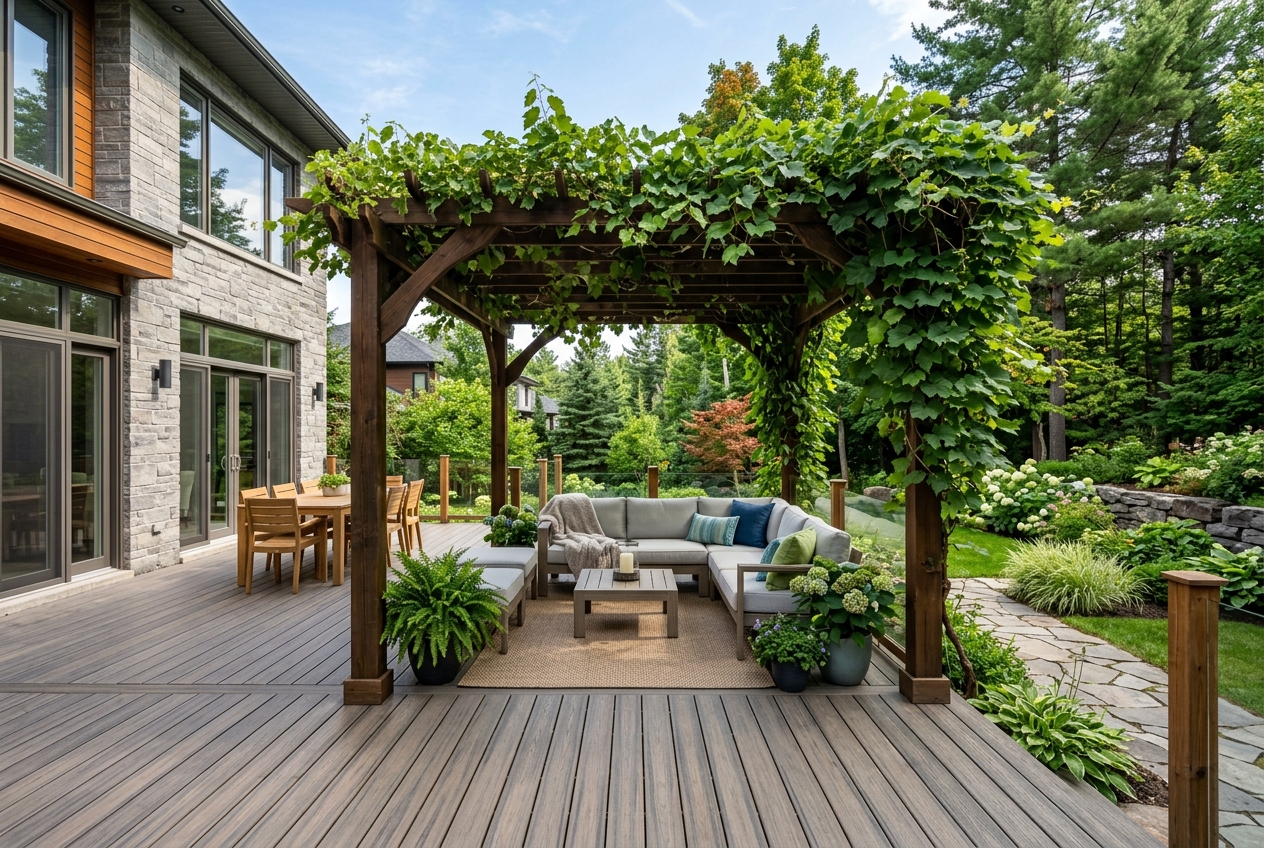
Creating a cool oasis on your patio in the heart of the Quebec summer
Summer in Quebec is a season we all look forward to, but when July and August roll around, temperatures soar. Heatwaves often turn our backyards into veritable ovens, making outdoor afternoons sometimes uncomfortable. While your composite deck is the ideal place to enjoy the beautiful season, direct sun exposure can limit its use during the hottest hours of the day. Unlike our previous article that explored the art of container gardening, today we are focusing on a highly effective architectural and botanical solution: using climbing plants on trellises or pergolas to generate natural, dense, and refreshing shade.
Integrating plant structures into your outdoor living space is not just a matter of aesthetics. It's a true landscaping strategy that naturally cools your patio while creating a spectacular privacy screen. The leaves of climbing plants not only block UV rays, but they also cool the ambient air through the process of evapotranspiration. However, marrying nature with engineered materials requires a certain know-how. In this comprehensive guide, we will explain how to select the best climbing species adapted to the Quebec climate, how to design your shade structures, and above all, how to integrate these elements without ever compromising the integrity of your precious composite boards.
The challenge of summer heat and the plant cover solution
In the middle of summer, especially during the famous construction holiday, the sun beats down hard on our outdoor layouts. A south-facing deck can store an impressive amount of heat. Although an umbrella or a canvas awning can offer immediate respite, these artificial solutions tend to trap hot air beneath their surface. Conversely, a plant cover acts as a natural air conditioner. The shade generated by a foliage-covered pergola is always cooler and more breathable. Plants absorb solar energy for photosynthesis instead of reflecting it, creating an exceptionally comfortable microclimate for your summer relaxation sessions or al fresco dining.
Protecting your investment: golden rules for composite
One of the greatest advantages of modern materials is their exceptional durability against the elements. Whether you have opted for boards from renowned brands like Fiberon, TimberTech, Trex or TruNorth, your patio is designed to resist rot, insects, and splintering. However, integrating climbing plants requires a few precautions so as not to damage this beautiful surface. The golden rule is to avoid direct and prolonged contact of moist soil and roots with the decking. Support structures must be designed to allow good air circulation between the vegetation and the floor, thus preventing the accumulation of stagnant moisture which, although composite is very resistant to it, could long-term cause water stains or promote the appearance of surface mold.
Choosing the right structure: trellis, pergola, or arbor?
The choice of structure will depend on the desired effect and the orientation of your yard. A classic pergola, with its slatted roof, is ideal for creating an overhead shade zone above your dining table or patio furniture. It's the ultimate option for midday meals. The vertical trellis, on the other hand, is perfect for blocking the low late-day sun, while acting as a privacy wall against neighbors' prying eyes. Finally, the arbor offers a romantic shaded passageway, often used to mark the transition between the deck and the rest of the backyard. Whichever option you choose, make sure it is built with sturdy materials capable of supporting the considerable weight of a mature climbing plant soaked with water after a summer storm.
Anchoring structures: avoiding drilling into your boards
This is where technical expertise comes into play. To preserve the warranty and integrity of your composite deck, it is strongly advised against screwing or anchoring trellises directly into the surface boards. Instead, favor fastening to the fascia (the finishing border) or directly onto the underlying treated wood structure. Another excellent alternative is to use large, freestanding, and weighted planter boxes that integrate a sturdy trellis. This modular solution allows you to create removable green walls without making a single hole in your patio. These planters should be equipped with rubber pads or casters to slightly elevate the container, ensuring adequate drainage of watering runoff away from the composite fibers.
Hops (Humulus lupulus): explosive growth for quick shade
If you are in a hurry to enjoy a shaded area by July, hops are the undisputed champion of rapid growth. This extremely vigorous perennial can climb several meters in the span of just a few weeks. Perfectly hardy in Quebec, hops regrow vigorously every spring from their roots. Their light green, ample, and textured foliage offers dense and refreshing shade. Moreover, at the end of summer, they produce pretty pale green cones that add undeniable visual interest and a light herbaceous scent to your summer evenings. Just make sure to provide them with solid support, as their plant mass becomes very heavy in peak season.
Clematis: spectacular flowers for your summer evenings
For those who wish to combine shade with dazzling floral aesthetics, clematis is a top choice. Although it offers slightly less dense shade than other species, it more than makes up for it with its abundant blooming that often stretches from July to September. To successfully grow it in Quebec, you must respect a fundamental principle: clematis likes its head in the sun and its feet in the cool. Plant it in a large, well-insulated planter and protect the base of the plant with other small plants or decorative mulch. On a wooden or lacquered metal trellis bordering your relaxation space, its large star-shaped flowers will bring an incomparable touch of elegance to your summer gatherings.
Virginia creeper (Parthenocissus): the timeless and majestic classic
Virginia creeper is undoubtedly one of the most iconic climbing plants in North American landscaping. It is particularly appreciated for its ability to quickly cover large surfaces, such as pergola roofs. In the middle of summer, its foliage composed of five leaflets creates a veritable roof of greenery, effectively blocking the sun's rays while letting a soft, filtered light through. However, caution is required: Virginia creeper clings using very powerful little suction cups. It is crucial to guide it exclusively on your pergola or trellis and prevent it from reaching your home's siding or the structural elements of your deck, where its holdfasts could be difficult to clean off.
Dutchman's pipe (Aristolochia macrophylla): maximum coolness
If your main goal is to create a totally impenetrable wall of shade to counter heatwave days, Dutchman's pipe is the plant for you. Its huge heart-shaped leaves overlap very tightly, creating an exceptional visual and thermal barrier. It is the ideal plant to cover the sides of a west-facing pergola, where the late afternoon sun is the most oppressive. Very hardy (zone 4), it perfectly survives Quebec's harsh winters. Its dense foliage offers a cool and peaceful refuge, ideal for reading a book or taking a nap sheltered from the blazing August sun.
Climbing honeysuckle (Lonicera): a captivating scent for entertaining
Designing a deck engages not only sight but also smell. Climbing honeysuckle is famous for the sweet and suave fragrance of its tubular flowers, a scent that intensifies particularly at nightfall. It is the perfect species to grow on a trellis located near your dining area or outdoor lounge. In July and August, while you entertain guests for a prolonged dinner or simply enjoy your staycation, the scent of honeysuckle will transform your patio into a true sensory oasis. Additionally, its flowers attract hummingbirds and butterflies, adding life and movement to your layout.
Arctic kiwi (Actinidia kolomikta): a touch of Nordic exoticism
For a surprising and unusual visual effect, the Arctic kiwi is a fascinating option, particularly well suited to the Quebec climate (hardy down to zone 3). Contrary to what its name might suggest, it is cultivated primarily for its spectacular foliage rather than its fruit. In early summer, the leaves of the male plant are tinged with white and bright pink, giving the impression that the plant is covered in large flowers. This twining vine is excellent for climbing along the posts of a pergola, offering light shade while bringing a touch of vibrant color that contrasts beautifully with the neutral and modern tones of your composite deck.
Hardy climbing roses: romantic elegance for relaxation
Although they require a bit more attention to be guided and tied (since they do not cling on their own), climbing roses developed for the northern climate, like those in the Explorer series (e.g., William Baffin or John Cabot), are magnificent choices. They create a romantic and sophisticated English garden atmosphere. Trained on a large privacy trellis, they offer generous blooming in the middle of summer. The shade they provide is less dense than that of a vine, which is perfect if you want to maintain good brightness on your patio while breaking the direct view and softening the architectural lines of your outdoor space.
Annual climbing plants: the no-commitment solution
If you are not ready to commit to a perennial plant or if your trellis structure is temporary, annual climbing plants are a fantastic alternative. Morning glory, scarlet runner bean, or climbing nasturtium grow at a dizzying speed from simple seeds sown in June. By mid-July, they can cover an entire trellis, offering generous shade and colorful flowers throughout the peak summer heat. It's an excellent way to test the location of a future permanent green wall or to change the style of your deck from one year to the next, without any risk to your installations.
Summer maintenance of your climbers during heatwaves
For your climbing plants to provide optimal shade in July and August, they need water. A lot of water. The radiant heat from your patio can accelerate soil evaporation, especially if your plants are in planters. It is crucial to establish a rigorous watering routine, ideally early in the morning or late in the evening. Always water at the base of the plant to encourage deep rooting, and avoid wetting the foliage to prevent fungal diseases. Adding a good organic mulch to the base of your plantings will help retain moisture and keep roots cool during the most scorching days of the Quebec summer.
Managing plant debris to keep your patio spotless
Nature is generous, but it can also be a bit messy. Climbing plants will inevitably lose some leaves, and flower petals will fall onto your deck. Although high-quality composite boards are extremely stain-resistant, it is recommended not to let piles of wet leaves decompose on the surface for weeks, as the natural tannins of the plants could eventually mark the material. A simple weekly sweep or the use of a lightweight leaf blower is more than enough to keep your living space spotless. That is the beauty of composite: a quick cleaning with soapy water is enough to restore its original shine.
Trellis-integrated lighting: prolonging the magic of summer evenings
Shade is essential during the day, but ambiance is paramount at night. Take advantage of your plant structures to integrate outdoor lighting solutions. Bistro-style string lights intertwined in the branches of your Virginia creeper or hops create a magical atmosphere, worthy of the finest open-air restaurants. This subdued lighting, filtered by the foliage, is perfect for prolonging your summer evenings well after sunset. Make sure to use outdoor-certified LED lights, which do not emit heat that could burn the delicate leaves of your climbing plants.
Staycations: creating a peaceful oasis on your deck
More and more Quebecers are choosing to spend their summer vacations in the comfort of their own homes, a trend often called a "staycation". In this context, your backyard must become your destination of choice. By combining the modern comfort of your composite patio with the lushness of a pergola shaded by climbing plants, you recreate the relaxing atmosphere of a tropical resort, but adapted to our climate. Add comfortable outdoor furniture, a few colorful cushions, and let the rustling of leaves in the summer breeze transport you far from daily stress, all while staying just steps away from your kitchen.
Control pruning: maintaining harmony between nature and structure
In the heart of summer, the growth of certain vines can become exuberant, sometimes threatening to invade your deck's living space. A light control pruning in July or August is often necessary to clear walkways, prevent stems from infiltrating under the composite boards, or obstructing your outdoor lighting. Use clean, sharp pruning shears to cut back rebellious shoots. This summer pruning not only maintains the aesthetics of your landscaping, but it also encourages the plant to densify its foliage where you need it most for shade.
Preparing for the end of summer: a smooth fall transition
As August draws to a close and evenings begin to cool, your climbing plants will begin their transition. This is the time when species like Virginia creeper will start preparing for their spectacular color change, promising a blazing autumn. It is also the ideal time to evaluate the season's growth and plan any potential adjustments to your support structures for the following year. Gradually reducing watering will help your perennials harden off (toughen their stems) in anticipation of the first frosts, thus ensuring their survival and vigorous return next spring.
The perfect harmony to fully enjoy your outdoors
In short, adding climbing plants to trellises or pergolas is one of the most elegant and effective methods to maximize the comfort of your composite deck during the Quebec summer. This symbiosis between the technological durability of modern materials and the organic beauty of nature creates a balanced, cool, and welcoming outdoor living space. With the right plant selections and installation methods that respect your decking, you ensure years of summer enjoyment in the shade of your own private oasis.