

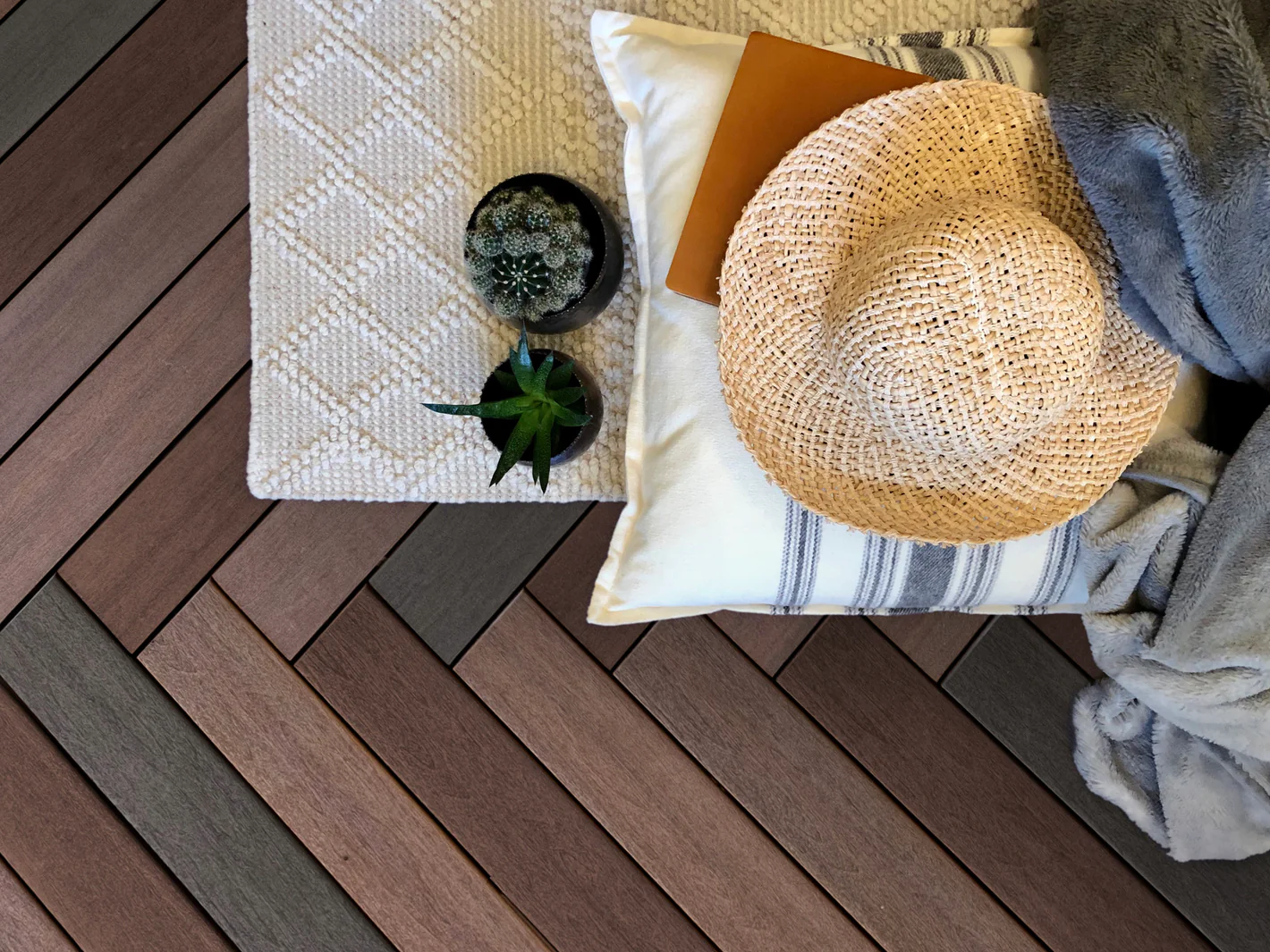
Design the Ideal Foundation for Your Composite Deck
Technical note: Installation details vary by municipality, product line, board profile, fastening system, loads, and site conditions. Use this article as general guidance only; confirm the final design with your local building department, the manufacturer's current installation guide, and a qualified contractor or engineer when structural loads are involved.
In Quebec, a true composite deck must rest on a solid and durable structure. Whether you choose Fiberon, TimberTech, Trex, or TruNorth boards, the choice between a flush beam and a drop beam influences the aesthetics, performance, and maintenance of your deck. In this guide, we will walk you through understanding these two solutions and selecting the one that best suits your outdoor living space in Quebec.
Why choose a flush beam for your composite deck?
What is a flush beam?
The flush beam is a structural element positioned in the same plane as the joists. It blends perfectly beneath the deck boards and creates no level difference, ideal for a clean, modern look. On a patio attached to the house, the "ledger board" often serves as a flush beam.
Advantages and disadvantages
- Vertical space gain: You save up to 11 inches under the structure, practical for a low-level patio or uneven terrain.
- Refined aesthetics: No visible protrusion, compatible with cappuccino, charcoal, driftwood, or cabin grey colors of TimberTech and Trex boards.
- Railing installation: Some railing systems need to be adapted, as the flush beam does not always meet standard manufacturer tests.
- Increased complexity: Requires a double rim joist to uniformly embed the boards and railing elements.
"Precision in beam installation ensures optimal longevity of composite decks in our Quebec climate." - Outdoor Living Expert
Comparison with the drop beam
What is a drop beam?
The drop beam is located below the joists, creating a vertical offset. Commonly used on elevated decks, it facilitates inspection and replacement of joists without disassembling the structure.
Key installation differences
- Visibility: The drop beam is visible under the deck, while the flush beam is invisible.
- Accessibility: Easier to access for maintenance, but it can reduce the free space under the deck.
- Terrain adaptation: The drop beam solution is suitable for flat terrain, while the flush beam is ideal for low-level decks or slopes.
- Compatibility: With a Fiberon composite deck, ensure that the minimum required space between the ground and the underside of the boards is respected (generally 4 to 6 inches).
Essential tools and materials
Recommended tools
- Bubble level or laser level: Essential for marking the beam height.
- Circular saw and reciprocating saw: For adjusting joists and lumber.
- Tape measure and carpenter's pencil: For precise measurements.
- Ladder or stepladder: Safe access at height.
- Wrench and drill-driver: For bolting the structure.
- Mallet and hammer: For positioning elements before tightening.
Required materials
- Beams and joists: Treated wood or galvanized steel, sized according to the loads planned by the engineer.
- Assembly cleats: Flush beams and rim joists (double rim joist) to support composite boards.
- Galvanized bolts and screws: Ensure resistance to frost and corrosion, essential in Quebec.
- Hangers and joist hangers: Certified for treated wood exposed to the elements.
Steps for installing a flush beam
Step 1: Determine the cut height
Mark on each post the elevation corresponding to the top of the joists of your composite deck. Use a laser level to transfer this measurement to all supports.
Step 2: Pre-assemble the beam
Assemble the flush beam by combining several pieces of lumber if necessary. Use galvanized nails and respect the positioning of the joints above the posts.
Step 3: Groove the posts
Cut a notch in each post so that the beam fits into it. The top part of the beam must be flush with the final level of the joists.
Step 4: Secure permanently
After insertion, hold the beam firmly, then bolt it using 1/2-inch threaded rods and large washers. Maintain a 1/4-inch clearance under the bolt heads to avoid wood compression.
Step 5: Install joists and composite boards
Install hangers conforming to Trex, TimberTech, or Fiberon requirements. Make sure to leave a minimum gap under the boards for good ventilation and to prevent moisture buildup.
Maintenance and practical tips
Prevention and durability
To ensure the longevity of your structure:
- Clean regularly under the deck to prevent debris accumulation.
- Check fasteners before the summer season and after winter.
- Apply a treatment to exposed wood parts to slow down wear.
- Inspect hangers and bolts for any premature corrosion.
Conclusion
Whether you are planning a low-level patio or an elevated deck, the choice between a flush beam and a drop beam is crucial for the performance and aesthetics of your outdoor living space in Quebec. Our experts at Magasin de Patio advise you on the best approach for your project, whether you choose TruNorth, Trex, Fiberon, or TimberTech boards. Benefit from a reliable structure, compliant with applicable local requirements, while enhancing your outdoor space.
Ready to transform your deck?
Contact our specialists for a personalized study and start your composite deck project today.