

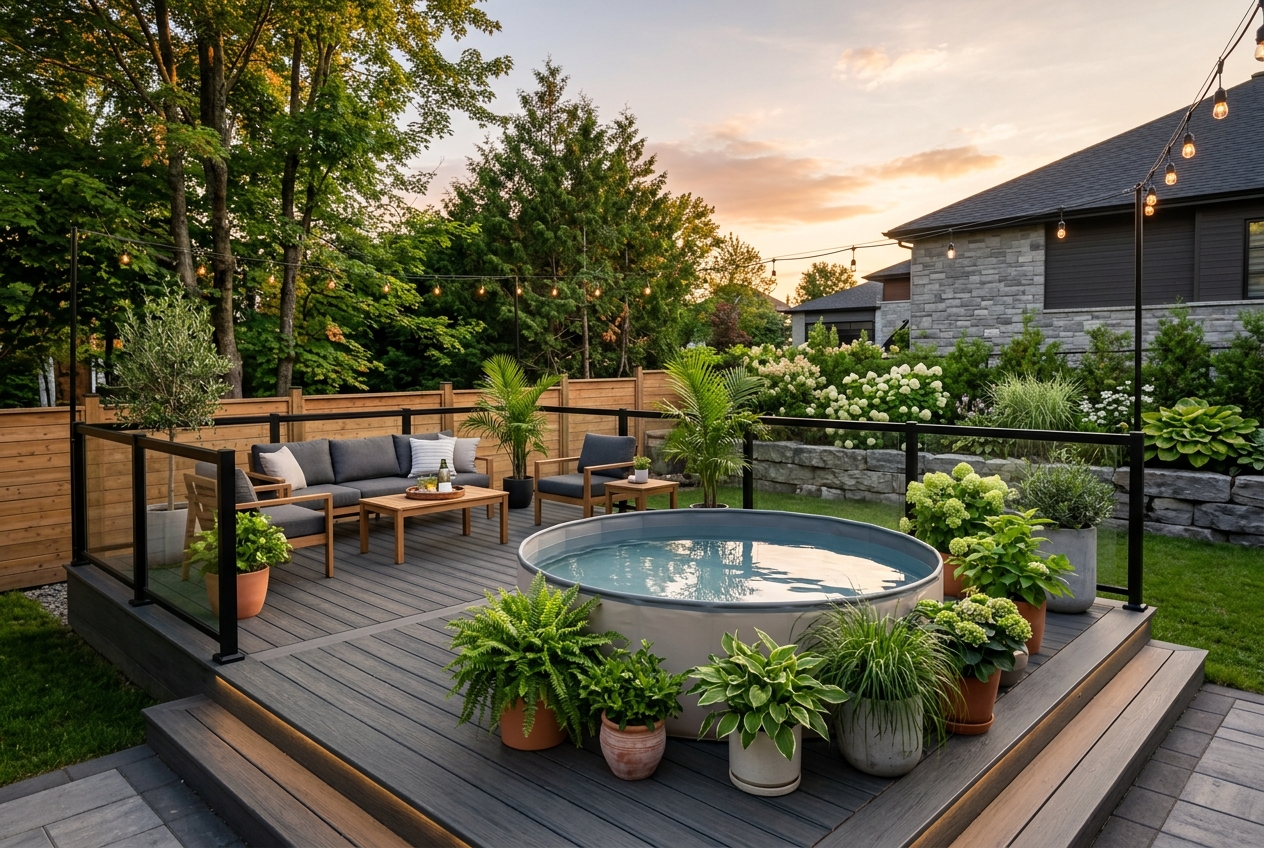
Kiddie pools and summer basins: safely installing a temporary pool on your patio
Summer in Quebec is a season as highly anticipated as it is intense. When the months of July and August settle in, they often bring with them stifling heatwaves that transform our backyards into veritable oases in search of coolness. For many Quebec families, the composite deck becomes the nerve centre of summer activities, the prime spot for hosting guests, organizing evening barbecues, and enjoying a staycation. In this quest for thermal comfort, adding a small inflatable pool, a kiddie pool for the children, or a temporary summer basin seems like the perfect idea to cool off quickly without leaving the comfort of your patio.
However, this spontaneous decision, often made on a hot weekend day, hides insidious risks that most homeowners are unaware of. Unlike a hot tub, whose installation is planned and structure reinforced right from the patio's construction, a temporary pool is often placed directly on the composite boards without prior assessment of the structure's load-bearing capacity. The colossal weight of the water, combined with the challenges related to stagnant moisture under the basin, can not only damage the aesthetics of your investment but also cause a catastrophic structural collapse. At Magasin de Patio, we believe it is essential to understand these issues to enjoy your summer safely. Here is our complete guide to evaluating, preparing, and protecting your composite deck against the challenges of summer basins.
1. The call of coolness: summer heatwaves in Quebec
The Quebec climate is known for its extremes. While our winters are harsh, our summers, particularly in the heart of July and August, can be marked by oppressive heatwaves accompanied by very high humidity levels. During these periods, the concept of a "staycation" or holidaying at home takes on its full meaning. The backyard transforms into a sanctuary of relaxation. We add lush potted plants, install shade sails to protect ourselves from the sun's burning rays, and seek by all means to integrate a water feature. The kiddie pool then becomes the central element of hot days and warm summer evenings, offering immediate relief to children and adults alike. However, this addition drastically alters the originally intended use of your outdoor platform.
2. Kiddie pool vs. Hot tub: the false belief of reinforcement
A common mistake is comparing the installation of a kiddie pool to that of a hot tub. It is true that many composite decks in Quebec host majestic hot tubs. However, there is a fundamental difference: the intention. When a contractor builds a patio intended to accommodate a hot tub, they design a specific section of the structure with closely spaced joists (often at 12 inches or even 8 inches), oversized beams, and additional screw piles capable of supporting thousands of pounds. Conversely, buying an inflatable pool at a department store is often spontaneous. It is placed in the middle of the patio, on a standard section designed only to support the weight of furniture, the barbecue, and guests, thus creating a dangerous and unforeseen overload.
3. The weight of water: a relentless mathematical calculation
To understand the danger, we must look at basic physics: water is extremely heavy. One litre of water weighs exactly one kilogram (about 2.2 pounds). A small rectangular pool of just 2 metres by 1.5 metres, filled to a modest depth of 50 centimetres, contains 1,500 litres of water. This represents a dead weight of 1,500 kilograms, or over 3,300 pounds! Placing such a mass on your patio is literally equivalent to parking a compact car on it. And this calculation does not even take into account the weight of the children or adults bathing in it, nor the dynamic force generated by the movement of the water as they play. This weight concentrated on a small surface area is the main enemy of your treated wood structure beneath the composite.
4. Evaluating the load capacity of your existing patio
In Quebec, the Building Code establishes strict standards for residential decks. Generally, a standard patio is designed to support a "live load" (the weight of people, snow, furniture) of about 40 pounds per square foot, plus a "dead load" (the weight of the materials themselves) of about 10 pounds per square foot. Let's return to our example of a 1,500-litre (3,300-pound) pool spread over an area of about 32 square feet. The exerted load easily exceeds 100 pounds per square foot! That is more than double what the standard structure can safely tolerate. Before filling a basin, it is therefore imperative to know the spacing of your joists, the span of your beams, and the capacity of your foundations (piles or concrete blocks).
5. The warning signs of a structure under stress
If you have already installed a temporary pool without reinforcing the structure, you must be extremely vigilant for signs of distress in your patio. An overloaded structure does not always collapse all at once; it gives warnings. Pay attention to joists that begin to bow or sag under the composite decking. Listen closely: ominous creaks coming from the framing lumber or metal fasteners (joist hangers) are major red flags. Notice if the deck seems to bounce abnormally when you walk near the pool, or if the railings suddenly seem misaligned. If you observe any of these symptoms, immediately drain the water from the pool to release the pressure.
6. How to reinforce the structure for temporary basins
If you plan to make the kiddie pool an annual summer tradition, the wisest solution is to preemptively reinforce the dedicated area. This usually involves working under the patio. You can add extra joists to reduce the spacing between them (going from 16 inches to 8 inches centre-to-centre, for example). Adding blocking between the joists will help distribute the weight more evenly. In some cases, it will be necessary to add an extra support beam resting on new screw piles or concrete footings anchored below the frost line. Although this represents an investment, it is the only way to guarantee the absolute safety of your family and guests.
7. The impact of stagnant moisture on your deck
Beyond the risk of collapse, the other major danger of temporary pools concerns the very surface of your deck. Although composite boards are renowned for their exceptional resistance to rot and water, they are not designed to be smothered under a waterlogged plastic tarp for weeks. The bottom of the inflatable pool creates a perfect microclimate for trapping moisture, dirt, pollen, and debris. With the crushing heat of July and August, this stagnant moisture trapped between the bottom of the pool and the composite boards becomes the ideal breeding ground for the proliferation of surface mould, algae, and stubborn stains that can tarnish the appearance of your beautiful patio.
8. Protecting the boards from mould and discoloration
To preserve the aesthetic integrity of your investment, it is crucial never to leave a kiddie pool in the same spot all summer. The best practice is to empty and move it every three or four days. This allows the composite boards to breathe, dry completely in the sun, and avoid grime buildup. Take advantage of moving the pool to sweep or rinse the area with clean water. If you leave the pool in place for longer, you risk discovering a large discoloured or stained circular mark at the end of the season, due to the accumulation of minerals, water chemicals (if you use them), and the lack of UV exposure compared to the rest of the patio.
9. The importance of choosing premium quality materials
Your deck's ability to withstand the assaults of stagnant water and repeated splashing depends greatly on the quality of the materials chosen during its construction. First-generation, un-encapsulated composites were much more vulnerable to moisture absorption. Today, by opting for recognized brands like Fiberon, TimberTech, Trex or TruNorth, you benefit from advanced co-extrusion (encapsulation) technology. These boards are covered with a protective polymer shield on three or four sides, offering a nearly impenetrable barrier against water, sunscreen stains, mild chemicals, and mould. While this does not exempt you from proper maintenance, it is invaluable peace of mind for active families.
10. Creating strategic shade zones for the water and patio
In summer, the sun beats down hard in Quebec. Placing your kiddie pool in direct sunlight can make the water unpleasantly hot and expose children to sunburn. Furthermore, dark composite boards can become very hot under bare feet. Setting up shade zones is therefore essential. Integrating pergolas, large cantilever umbrellas, or shade sails over the swimming area will not only protect the bathers but also help regulate the surface temperature of your deck. A shaded area also reduces rapid water evaporation and creates a much more relaxing atmosphere for enjoying long summer evenings while sipping a cold drink.
11. Protective mats: a falsely good idea?
Many homeowners think they are doing the right thing by placing interlocking foam mats or protective tarps under the pool to protect the composite from scratches and provide a softer bottom for children. While the intention is good, this can exacerbate the moisture problem. These mats act like sponges or additional waterproof barriers, trapping even more water and preventing any air circulation between the boards. If you must use a protective mat, it is all the more imperative to dismantle the setup frequently, hang the mats to dry, and clean the patio surface before reinstalling everything.
12. Safety first: railings and slips
A pool on a patio inevitably means splashing and water everywhere. Although modern composite boards, like those from the previously mentioned brands, feature textures mimicking wood grain to offer some slip resistance, any wet surface becomes potentially slippery. It is crucial to establish strict rules with children: no running around the pool. Additionally, ensure that your deck's railings comply with the Building Code, with adequate height and balusters spaced less than 4 inches apart, to prevent any risk of accidental falls off the patio during boisterous water play.
13. Water drainage: emptying the pool smartly
When it comes time to change the water or put the pool away, the drainage method is crucial. Emptying 1,500 litres of water all at once directly onto your patio boards is a very bad idea. This cascade of water will flow through the gaps, flood the wooden structure underneath, and above all, saturate the soil around your home's foundations or wash away the stone dust under the patio, which can cause settling or basement infiltration problems. Always use a garden hose connected to the pool's drainage valve to direct the water away from the house, towards a street drain, a ditch, or to water your plants, trees, and shrubs during dry spells.
14. Post-swim maintenance of your composite patio
After removing the temporary pool, take the time to give your deck a little love. If there are water rings, dirt residue, or the beginnings of pollen buildup, a simple cleaning is usually sufficient. Use a soft-bristle broom, warm water, and a mild soap (like dish soap) to gently scrub the area. Rinse thoroughly with clean water. Avoid overly powerful pressure washers that could damage the protective shield of your composite boards. Regular maintenance ensures that your patio will retain its shine and vibrant colour for many years to come, ready to host your next gatherings.
15. Staycation: maximizing the comfort of your yard
Integrating water into your outdoor landscaping truly transforms your yard into a resort. To maximize this staycation, think about the overall ambiance. Around the secured swimming area, arrange comfortable lounge chairs, add planters filled with tropical plants or grasses for a touch of greenery, and install soft ambient lighting (LED lights recessed into the composite or string lights). Your composite deck is not just a floor; it is an extension of your indoor living space, a place where summer relaxation must take precedence over maintenance hassles or structural insecurity.
16. Common mistakes to avoid during installation
To summarize, here is a reminder of the most common pitfalls to avoid to guarantee a worry-free summer on your patio:
- Ignoring the total weight: Never underestimate the mass of water. A small pool can weigh more than an empty hot tub.
- Leaving the basin in the same spot: Move the pool regularly to avoid mould and stains on the composite.
- Neglecting structural inspection: Before summer, always check the condition of your joists, beams, and metal joist hangers.
- Emptying the water improperly: Never release hundreds of litres of water directly onto the structure and near the house's foundations.
- Forgetting to dry the mats: If you use protectors under the pool, air them out frequently to put a stop to stagnant moisture.
By understanding these principles and respecting the limits of your structure, you will be able to fully enjoy the joys of summer, the laughter of children, and the coolness of an impromptu swim, all while protecting your beautiful outdoor space.