

Mosquito-Repellent Lighting: Which Bulbs to Choose to Prolong Your Summer Evenings on Your Deck Without Attracting Insects in Quebec
Summer in Quebec is a highly anticipated season. After long winter months, the arrival of mid-summer in July and August pushes us to live outdoors, transform our backyard into an oasis for staycations, and entertain guests until the early hours of the morning. However, as soon as the sun sets and the daytime heat gives way to the evening cool, an unwanted guest systematically makes an appearance: the mosquito. These pests can quickly turn a perfect moment of relaxation on your patio into a hasty retreat inside the house.
Rather than continually spraying yourself with chemical repellents or resigning yourself to staying in the shadows behind mosquito nets, did you know that the solution lies largely in your lighting design? Unlike general outdoor design guides that focus solely on aesthetics, this article dives deep into the science of light. We will explore in detail the impact of color temperatures, wavelengths, and LED bulb technologies to help you create a warm ambiance on your composite deck, all while becoming practically invisible to mosquitoes.
1. The Challenge of Summer Evenings in Quebec: Heat, Humidity, and Insects
The Quebec summer climate, especially in mid-summer, creates ideal conditions for mosquito proliferation. Days marked by intense heat and often humid evenings, combined with the shade of abundant vegetation in our backyards, offer a perfect habitat for these insects. When setting up your deck to enjoy your staycation, it is crucial to understand that your traditional lighting acts as a beacon in the night for these pests. Understanding their behavior is the first step to taking back control of your summer evenings.
2. The Science of Phototaxis: Why Does Light Attract Mosquitoes?
Insects, including mosquitoes and moths, exhibit a behavior called positive phototaxis. In nature, they use the light of the moon and stars to orient themselves and navigate at night. Introducing intense artificial lights to your patio disrupts their internal navigation system. They confuse your outdoor lighting with a celestial light source, which causes them to obsessively circle your fixtures. It is this exact phenomenon that we seek to outsmart through wise bulb choices.
3. The Light Spectrum and Insect Vision: A Matter of Nanometers
To choose the right anti-mosquito lighting, you must understand what the insect is capable of seeing. The human eye perceives wavelengths ranging from about 400 to 700 nanometers (from violet to red). Mosquitoes, on the other hand, have a visual spectrum shifted towards shorter waves: they see ultraviolet (UV) light, blue, and green extremely well (between 300 and 650 nanometers). Conversely, they are practically blind to longer wavelengths, namely yellow, orange, and red. Thus, a light that seems warm to us will simply be invisible to them.
4. The Crucial Importance of Color Temperature (Kelvin Degrees)
On the packaging of every bulb, you will find a measurement in Kelvin degrees (K) that indicates the color temperature of the emitted light. This is the most important data for your deck lighting:
- 5000K to 6500K (Daylight/Bluish): This is an absolute magnet for mosquitoes. To be avoided at all costs on a patio.
- 3000K to 4000K (Neutral White): Still attracts a significant amount of insects, although less than daylight.
- 2000K to 2700K (Warm White to Amber): The sweet spot. This yellow/orange light is not perceived by the mosquitoes' navigation system.
5. Why Amber Light is Your Best Ally for Relaxation
Opting for bulbs with a temperature around 2200K (amber light) kills two birds with one stone. Not only does this warm yellow hue make you invisible to mosquitoes, but it also creates an incredibly relaxing ambiance, reminiscent of the glow of a campfire or a sunset. It is the ultimate lighting to promote relaxation, reduce stress after a long workday, and establish a friendly atmosphere when you decide to entertain guests during warm July evenings.
6. LED vs. Incandescent Bulbs: The Essential Technological Choice
The color of the light is not the only factor; the bulb's technology is just as vital. Traditional incandescent and halogen bulbs are extremely inefficient: they convert nearly 90% of their energy into heat rather than light. However, mosquitoes are equipped with sophisticated thermal receptors designed to detect the body heat of mammals. A hot incandescent bulb therefore acts as a massive thermal lure. LED bulbs, on the other hand, emit practically no infrared heat, thus eliminating this major attraction signal.
7. Daytime Heat, CO2 Emissions, and Lighting: The Complex Equation
In the middle of summer, the heat stored by your yard during the day dissipates slowly in the evening. If you add to this the carbon dioxide (CO2) that you and your guests exhale (another major attractant for mosquitoes) and the heat from older bulbs, your deck becomes a prime target. Exclusively using LED technology ensures you don't add an artificial heat source to your immediate environment, keeping your entertaining space as cool and undetectable to pests as possible.
8. The Famous "Bug Lights": Myth or Reality?
In Quebec hardware stores, you will often see bulbs marketed as "Bug Lights," usually covered with a yellow coating. Do they really work? Yes, but provided they are LED bulbs. A yellow-painted incandescent bulb will certainly filter out blue light, but it will continue to emit heat, attracting mosquitoes through other means. Therefore, make sure to buy LED "Bug Lights" to combine the absence of UV/blue emission with the absence of a thermal signature.
9. Highlighting Your Composite Deck Without Attracting Insects
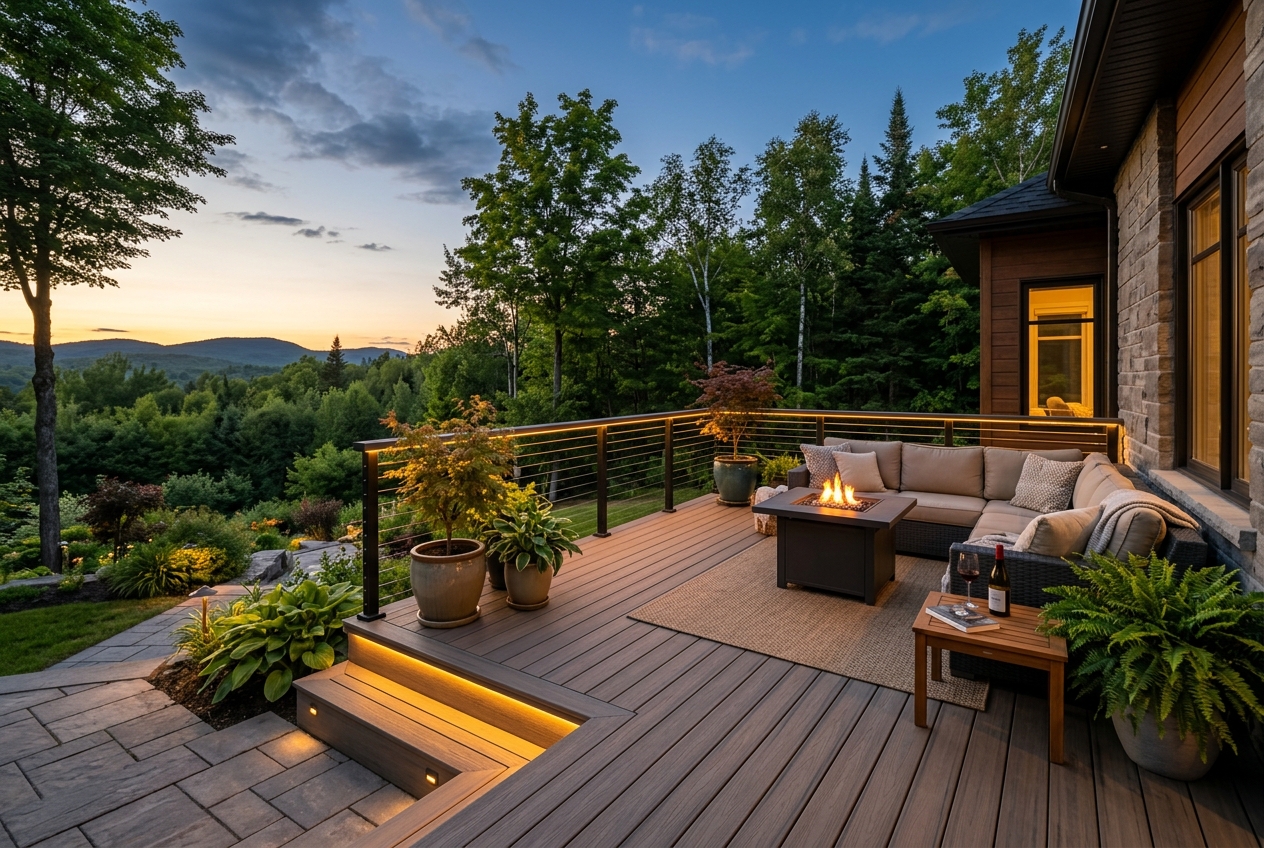
Lighting should also enhance your outdoor investments. Whether you have opted for boards from reputable brands like Fiberon, TimberTech, Trex or TruNorth, lighting plays a crucial role in highlighting the texture and wood grain of your composite deck. Amber light (2200K to 2700K) is particularly flattering for the natural wood, rich brown, or warm gray tones of these premium materials. Furthermore, since LEDs do not emit UV rays, they will not contribute to the premature fading of your patio furniture or accessories.
10. Recessed Lighting: Safety and Ambiance at Ground Level
Integrating recessed LED lights into your stair risers or around the perimeter of your composite patio is an excellent strategy. By using low-intensity, warm-colored LED bulbs for these recessed fixtures, you ensure the safety of your guests as they move around at night without creating a massive light halo that would attract insects from the whole neighborhood. Grazing light highlights the quality of your installation while keeping the light source discreet.
11. String Lights: Creating a Perfect Summer Space
Nothing screams "staycation" more than beautiful string lights suspended over an outdoor dining table or a relaxation area. To enjoy this aesthetic aspect without suffering from bites, choose "Edison" style string lights equipped with amber filament LED bulbs. They provide enough light to see what you are eating while respecting the golden rule of low color temperatures. Absolutely avoid cheap string lights that emit a cold, white light.
12. The Strategy of Landscape Distraction Lighting
Here is a professional lighting designer tip: use white light to your advantage by placing it strategically away from your patio. By installing a bright white LED floodlight (4000K or higher) at the other end of your yard, near a tree or an unused area, you will create a massive attraction point for insects. While mosquitoes and moths flock around this distant light, your deck bathed in amber light will remain a peaceful haven.
13. The Interaction Between Your Plants, Shade, and Lighting
Lush plants, shrubs, and shaded areas created by pergolas or shade sails are essential for protection from the daytime heat, but they also serve as refuges for mosquitoes. When designing your lighting plan, avoid shining lights directly on these dense vegetation areas located in the immediate vicinity of your seating. Lighting up the bushes where mosquitoes sleep will only wake them up and draw them toward your living space.
14. Entertaining Guests: The Art of Layering Light Sources
When hosting a summer dinner, a single type of lighting is rarely enough. The key is layering:
- Ambient lighting: Suspended amber LED string lights for a soft overall glow.
- Task lighting: Small rechargeable LED table lamps (always in warm white) to illuminate plates without glaring.
- Accent lighting: Recessed lights in your composite deck to safely define the space.
By controlling these different layers with dimmers, you can lower the light intensity as the evening progresses, further reducing your visibility to insects.
15. The Importance of Dimmers and Home Automation
Installing LED-compatible dimmers on your deck is a wise investment. The darker the night, the less light you need to see clearly, as your eyes adapt to the dark. By dimming your amber lights by 50% late in the evening, you correspondingly decrease the potential attraction radius of your patio. Smart lighting systems even allow you to program these transitions to happen automatically throughout the evening.
16. Staycation: Transforming Your Patio into a Lasting Oasis of Peace
By combining premium materials for your deck, smart landscaping, and a scientifically designed amber LED lighting system, you take back control of your Quebec summer. Evenings spent fighting mosquitoes or fleeing indoors will be a thing of the past. You will finally be able to fully relax, read a book, share a glass of wine, and enjoy the gentle night breeze in absolute comfort, maximizing every moment of the beautiful season.