

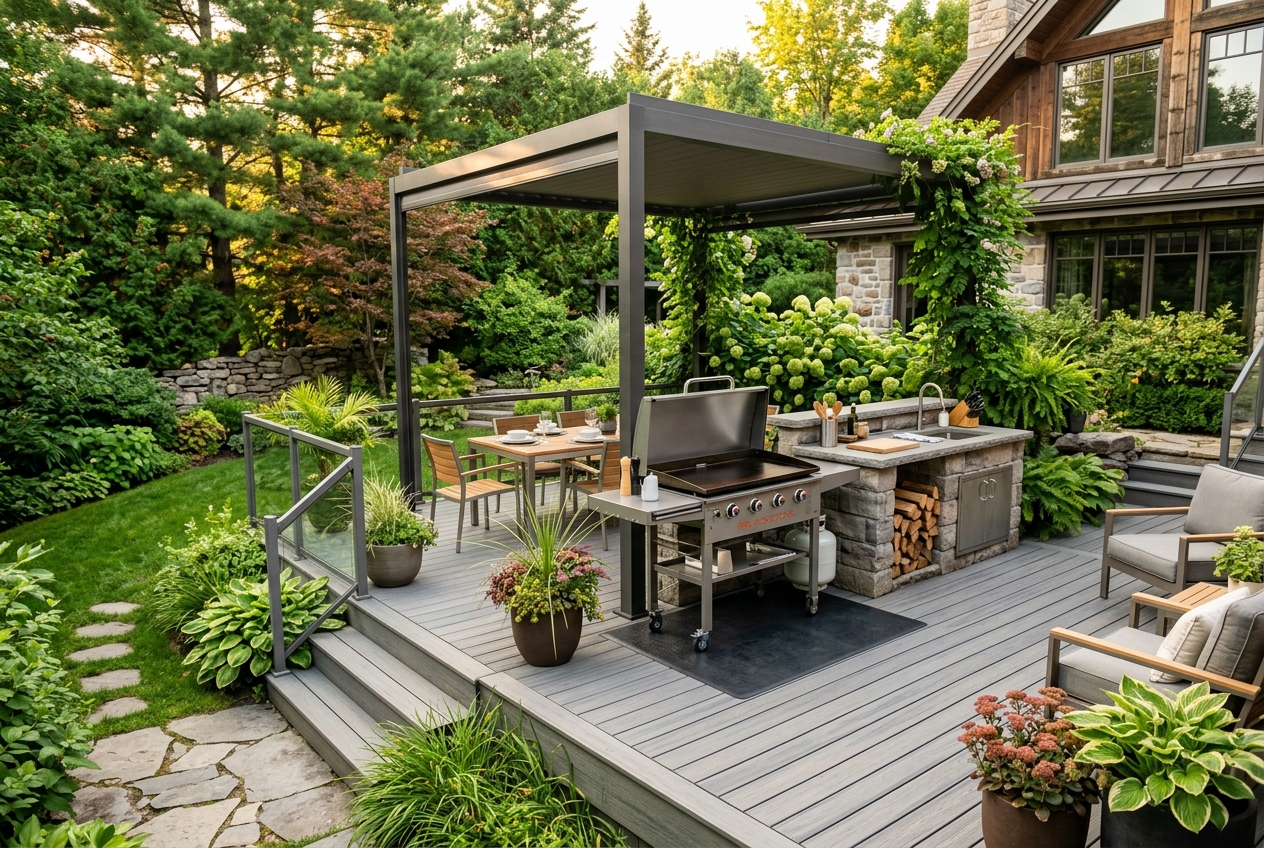
Plancha and griddle trend: integrating an outdoor cooking flat top on your composite deck in Quebec
In the very heart of the Quebec summer, as the months of July and August offer us hot days and mild evenings perfect for relaxing, our culinary habits inevitably move outdoors. While the classic barbecue has long reigned supreme in our backyards, a strong new trend has been firmly taking hold in recent years: the plancha and the griddle, often popularized by major brands like Blackstone. This flat-top cooking method is completely revolutionizing the way we prepare our summer meals, ranging from generous breakfasts with eggs and bacon to the famous late-day "smash burgers". Hosting guests becomes a truly interactive and convivial experience, where the chef remains at the center of the action while enjoying the relaxed vibe of a staycation, surrounded by greenery and good company.
However, installing an imposing outdoor flat top grill on a brand-new patio requires some specific precautions and rigorous planning. Unlike a pizza oven that concentrates its heat inside its dome or a traditional BBQ where the grease falls directly into a closed tub, the plancha generates intense and volatile grease splatters over a very wide perimeter. For Quebec homeowners who have wisely invested in premium quality materials for their landscaping, it is essential to know how to set up this prep space without risking damage to the luxurious surfaces. This article guides you step by step to harmoniously integrate your griddle on your composite deck, by managing the workspace, optimizing the shade, and above all, effectively protecting your boards against stubborn cooking stains.
1. The plancha craze in Quebec in the middle of summer
The months of July and August in Quebec are synonymous with sweltering heat, festive family gatherings, and long evenings spent outdoors. In this context of absolute relaxation and "staycations" (the famous holidays at home), the plancha stands out as the ultimate cooking equipment. Its immense cooking surface allows you to feed a large table of guests in record time. No more relentless and exhausting back-and-forths between the indoor kitchen and the patio: everything is prepared outside, under the sun. This trend is completely redefining the layout of our decks, which are no longer just passive resting areas, but true open-air kitchens where we enjoy every ray of sunshine and every summer breeze.
2. Plancha vs traditional BBQ: what changes for your patio
Integrating a griddle on your deck requires rethinking the overall ergonomics of your cooking space. A traditional barbecue generally cooks covered, with the lid down, thereby considerably limiting the dispersion of grease and odors into the surrounding air. Conversely, the plancha is a completely open surface, often very wide, which requires constant and dynamic handling of food with metal spatulas. The required prep space is therefore much larger. You will inevitably need drop zones on each side for your oil bottles, sauces, utensils, and serving platters. In addition, the heat released laterally makes it necessary to provide superior clearance from surrounding railings or garden furniture.
3. The number one enemy of your composite deck: cooking grease
Although modern composite decks are specifically designed to withstand the extreme weather of Quebec's harsh climate, they remain sensitive to certain aggressive chemicals and very hot fats. Cooking grease, particularly when splattered at high temperatures during a quick sear, is undoubtedly the number one enemy of your outdoor investment. If not cleaned up quickly, hot oil can seep into the micro-textures of the boards and leave dark stains that are very difficult to remove completely. This is the major and unavoidable challenge of flat-top cooking: the amount of fat used and splattered is significantly higher than that of a classic grill.
4. Why plancha splatters are more intense
The very technique of cooking on a griddle greatly favors unwanted splatters. Consider, for example, the preparation of smash burgers, an essential and highly prized summer recipe. The mechanical action of violently smashing ground meat on a scorching hot plate covered with oil or butter creates an immediate vaporization of animal juices and fats. These micro-droplets travel through the air, carried by the heat, and inevitably fall back onto your patio floor. The same goes for cooking bacon during an outdoor Sunday brunch, or for Asian vegetable stir-fries that require generously dousing the plate with oil and water. This radial dispersion of grease requires adequate and thoughtful protection for your flooring.
5. Protecting Fiberon, TimberTech, Trex, or TruNorth boards
Manufacturers of high-end composite materials have developed cutting-edge technologies to encapsulate their boards and make them highly resistant to everyday stains. Whether you have opted for Fiberon, TimberTech, Trex, or TruNorth boards, you benefit from a highly efficient protective polymer shell. However, this stain warranty often implies that spills must be wiped up within a reasonable time (usually 48 hours). With a plancha, the risk is not a simple accidental spill of wine or ketchup, but a daily and insidious accumulation of cooked grease micro-droplets. Even the best brands on the market strongly recommend the use of additional protection under high-splatter cooking appliances to preserve the perfect aesthetics of your patio in the long term.
6. The protective mat: the essential accessory under the flat top
The simplest, most effective, and most economical solution to protect your sumptuous composite deck is the installation of a barbecue protection mat (often called a "grill mat" in stores). This mat must be placed directly under your plancha and extend well beyond the sides and especially the front, where the cook stands. By catching all grease splatters, dropped food pieces, and sticky marinade drips, the mat acts as a true sacrificial shield. It is infinitely easier to hose down or replace an affordable protective mat than to try to remove baked-on, polymerized grease from composite boards.
7. How to choose the right protective mat for composite
Be careful, not all mats sold in hardware stores are suitable for composite decks. It is absolutely crucial to choose a mat specifically designed and certified for this particular use. Absolutely avoid mats with cheap rubber or latex backings, as these materials can chemically react with the composite surface under the intense summer heat and cause permanent discoloration (a phenomenon called plasticizer migration). Instead, opt for a fireproof, non-reactive rubber-free mat, often made from fiberglass coated with high-quality silicone or vinyl approved for composite. Also, ensure it is heavy enough not to blow away during the frequent wind gusts in Quebec.
8. Setting up the prep space around your griddle
Cooking on a plancha requires almost military organization for the experience to remain enjoyable. The action is fast, here is what you need to plan to optimize your space:
- Sturdy side counters: they are essential for placing your cutting boards, raw meats, and heavy cast-iron melting domes.
- A mobile rolling cart: perfect for grouping your water and oil sprayers, spatulas, and spices without cluttering the main cooking zone.
- Integrated side drop zones: by centralizing the prep in one place, you limit hasty movements across the deck and drastically reduce the risk of dropping greasy food on your beautiful boards.
9. Managing the summer heat: the importance of shade for cooking
In the middle of July and August, the late afternoon sun in Quebec can be truly relentless. With a plancha already giving off intense radiant heat (often over 400 degrees Fahrenheit on the plate), cooking in full sun can quickly become an exhausting and uncomfortable chore. It is therefore highly strategic to position your cooking zone in a naturally shaded area of your backyard, or to integrate an architectural shade structure like a cedar pergola, a motorized retractable awning, or a large commercial-grade cantilever umbrella. The shade will not only make the chef's experience much more pleasant, but it will also protect your guests from excessive heat and help maintain a milder temperature on the very surface of your composite deck.
10. Integrating plants and greenery for a "staycation" vibe
To soften the very industrial, massive, and metallic look of an imposing Blackstone-style plancha, there is nothing like integrating natural and living elements around your cooking zone. The strategic addition of planter boxes, hanging baskets, and large potted tropical plants helps create a true summer oasis conducive to relaxation and escape. Favor aromatic herbs (rosemary, basil, thyme, mint) in the immediate vicinity of the griddle: in addition to deliciously perfuming the ambient air under the effect of the heat, they will be directly accessible to season your grilled meats at the last minute. Just be sure to use elevated pots or pots equipped with adequate saucers to prevent stagnant watering from leaving unsightly rings on your composite.
11. Immediate cleaning: the right habits after a smash burger night
The absolute key to maintaining the luxurious shine of your composite deck season after season lies in post-cooking responsiveness. After a festive and lively evening preparing smash burgers for your guests, take a few minutes to carefully inspect the floor around the plancha once the appliance has completely cooled down. If stubborn splatters have breached the safe perimeter of your protective mat, clean them up without waiting for the next morning. The blazing sun the next day could "bake" and set the grease onto the composite surface, making the stain much more stubborn. A simple wipe with a damp microfiber cloth and a little mild soap is often enough to solve the problem if the intervention is quick.
12. Cleaning products to favor and avoid on composite
For the regular maintenance of your deck against inevitable culinary greases, it is crucial to make the right product choices:
- To favor without hesitation: warm water mixed with a mild dish soap (known for its powerful degreasing properties). Gently scrub the affected area with a soft nylon bristle brush, always in the direction of the board's grain to dislodge dirt, then rinse thoroughly with clear water.
- To absolutely avoid: highly abrasive cleaners, hard wire brushes, acetone, or pure bleach which could tarnish, scratch, or irreversibly destroy the protective layer of your precious Fiberon, TimberTech, Trex, or TruNorth boards.
- Pressure washer (Power washer): its use must be done with extreme caution, at very low pressure (under 1500 PSI) and with a wide fan tip, keeping a safe distance so as not to etch the surface.
13. Safety first: clearance and ventilation of the cooking zone
The permanent installation of a propane or natural gas flat top on a composite patio requires compliance with very strict safety standards to avoid any fire risk. The radiant heat at the back and sides of a griddle running at full blast is considerable. It is imperative to maintain a safe clearance (often clearly specified in the plancha manufacturer's manual, generally 24 to 36 inches minimum) from the vinyl-sided walls of the house, composite or aluminum railings, and any other combustible material. Furthermore, ensure the area has excellent natural ventilation to quickly dissipate intense cooking smoke and potential gas accumulations, especially if your deck is partially enclosed by privacy screens or covered by a solid roof.
14. Creating a fluid hosting zone for your guests
One of the greatest pleasures of cooking on a plancha is its eminently convivial and spectacular aspect. Your guests will naturally tend to happily gather around the flat top to watch the cooking, chat with the chef, and enjoy the mouth-watering aromas of the grilling meats. When designing and laying out your patio, you must absolutely consider this social dynamic. Create fluid circulation zones (a good "traffic flow") so people can approach without hindering the cook's rapid movements. Installing a bar counter with a few comfortable stools at a safe distance is an excellent way to visually define the cooking space while fostering the social interaction typical of beautiful summer evenings in Quebec.
15. Late-night lighting to extend your summer meals
The hot and humid days of the Quebec summer very often push us to eat dinner later, when the temperature finally becomes milder and the sun goes down. A good outdoor lighting system is therefore absolutely essential for cooking safely on the plancha after nightfall. The subtle integration of LED lights into your stair risers, on your railing posts, or under the edges of your composite deck creates an atmosphere that is both warm and secure. For the cooking zone itself, provide powerful directional lighting (like a heat-resistant articulated BBQ lamp or well-positioned recessed lights in your pergola) to clearly distinguish the color of your meats and guarantee perfect and safe cooking of your food.
16. Fully enjoying your outdoor investment in Quebec
Ultimately, adding a plancha or a large griddle to your composite deck is simply a fantastic way to maximize the use of your backyard during the short but intense beautiful Quebec season. By scrupulously following these tips for ergonomic layout and preventive protection, you ensure that the inevitable grease splatters and the rigors of intensive cooking will never tarnish the beauty of your investment. A well-designed deck, intelligently shaded, properly protected, and surrounded by lush greenery becomes the true beating heart of your home in the summer. It is the perfect place to relax after work, host loved ones with ease, and forge unforgettable memories around flavorful meals prepared in the open air.