

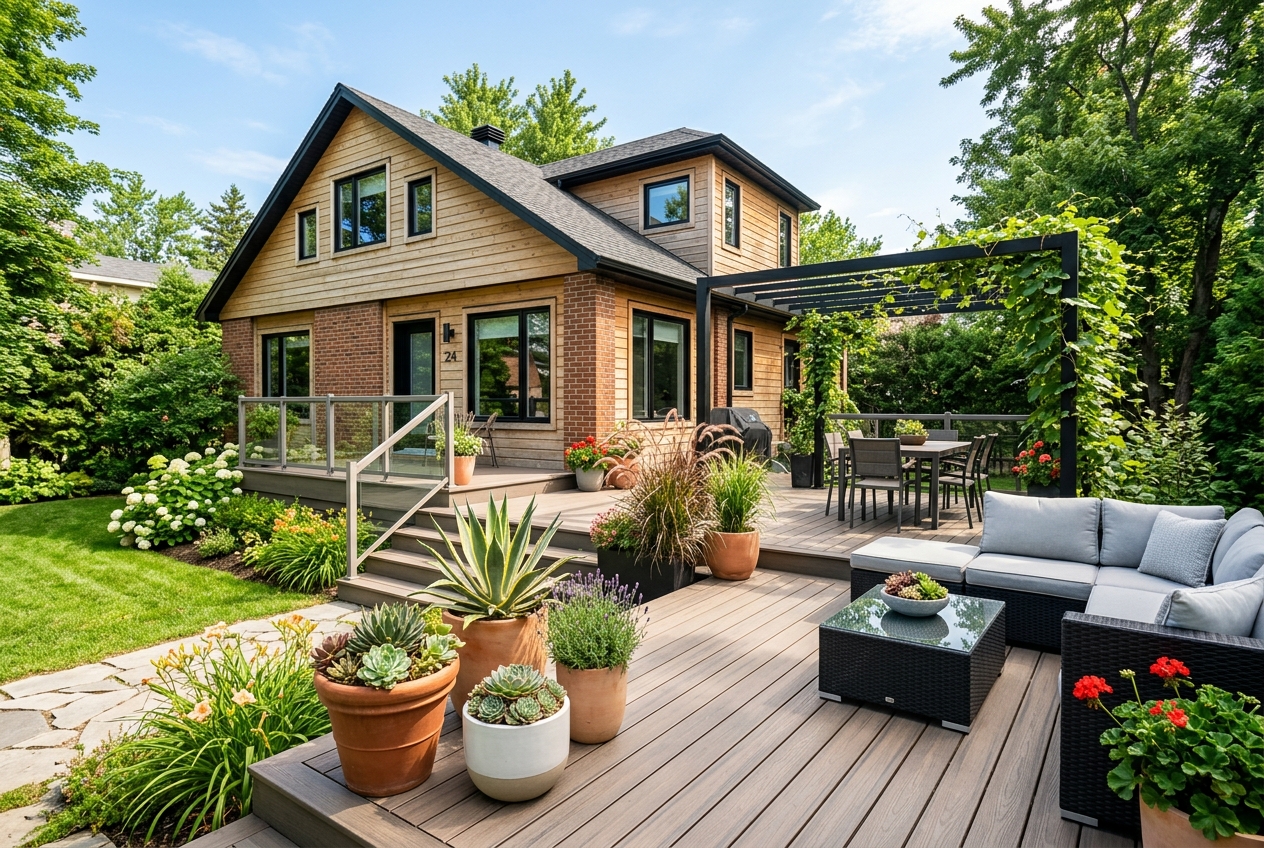
Adding blooms to your full-sun deck: the ultimate guide for Quebec heatwaves
Summer in Quebec is a beautiful season that we eagerly anticipate, but the months of July and August often bring their share of intense heatwaves. If you are lucky enough to have a full-sun patio, you know how much this space becomes the heart of your summer activities, whether it's for entertaining guests during long summer evenings, for a well-deserved staycation, or simply for a relaxing moment at the end of the day. However, the floral landscaping of this space can quickly become a major challenge. The beating rays of the afternoon sun, combined with radiant heat, can turn a beautiful traditional potted flower arrangement into a pile of dried leaves in just a few hours.
It is important to understand that premium materials like those from the Fiberon, TimberTech, Trex or TruNorth brands are designed to last a lifetime and withstand the harshest weather conditions of our climate, but they can naturally store heat under a blazing sun. To add flowers to a south-facing composite deck without becoming a slave to the watering can, we must rethink our botanical selection. This post focuses exclusively on drought-resistant plants, notably succulents and other heat champions, which will not only survive but thrive in these extreme conditions, offering you a true hassle-free summer haven.
The microclimate challenge on a full-sun deck
A south-facing deck creates a specific microclimate in your backyard. Composite boards, although extremely durable and aesthetically pleasing, absorb UV rays throughout the day and radiate a gentle heat in the evening. While this feature is perfect for extending your summer evenings outdoors, it creates an arid environment for potted plants. Water evaporation is much faster there than in a traditional in-ground flowerbed. It is therefore crucial to select plant species that have evolved to withstand desert or semi-desert conditions, in order to guarantee lush landscaping even in the middle of August.
Why succulents are the undisputed queens of summer
Succulents, or fat plants, are the ideal candidates for a scorching deck. Their secret lies in their anatomy: they have fleshy tissues, whether in their leaves, stems, or roots, specially designed to store water over long periods. This internal water reserve allows them to survive forgotten waterings and the worst Quebec heatwaves. Furthermore, their unique metabolism limits water loss through transpiration during the hottest hours of the day. By opting for these botanical wonders, you ensure a flawless decor while minimizing maintenance, which is the very essence of a successful staycation.
Sedums (Stonecrops): A diversity of shapes and colours
When talking about plants capable of surviving extreme heat, sedums are always at the top of the list. On a patio, they offer incredible diversity. Here is how to integrate them:
- Creeping sedums: Perfect for lining the edge of your pots and creating an elegant cascading effect.
- Upright sedums: Varieties like the famous 'Autumn Joy' provide an interesting vertical structure and produce flowers that attract butterflies.
- Colourful foliage: Many varieties offer shades ranging from apple green to deep burgundy, adding colour even without blooming.
Their resilience makes them allies of choice for any composite deck owner in Quebec looking to effortlessly beautify their space.
Hens and chicks (Sempervivum): The geometric survivors
Affectionately known as "hens and chicks", sempervivums are incredibly robust succulents. They form tight geometric rosettes that multiply quickly by producing small rosettes around the mother plant. These plants are not only tolerant to extreme heat and drought, but they are also hardy and can survive Quebec winters if they are subsequently planted in the ground. On your composite deck, they are perfect for shallow bowls or centrepieces, adding a fascinating architectural texture that is sure to catch your guests' eyes.
Agave: An exotic touch for a staycation
If you want to give your backyard a Southern resort look, agave is the plant for you. With its long, pointed, and fleshy leaves, often lined with small teeth, agave creates a dramatic and spectacular focal point. Placed in a large contemporary pot in a corner of your deck, it majestically structures the space. Although it loves to roast in the sun during the July heatwaves, remember that it is not hardy in Quebec; it will therefore need to be brought indoors before the first fall frosts to be enjoyed the following year.
Aloe (Aloe vera): The ultimate therapeutic plant
Aloe vera is much more than just a decorative plant; it is a true living pharmacy, particularly useful during the summer season. In addition to perfectly tolerating the radiant heat of your patio, its internal gel is known to soothe sunburns after a long day spent outdoors or minor accidental burns near the barbecue. Its long green leaves spotted with white bring an interesting verticality to your potted arrangements. It requires very moderate watering and prefers its potting soil to dry out completely between waterings, making it the ideal companion for hot summers.
Echeverias: Pure elegance for your centrepieces
To decorate your outdoor dining table where you love to entertain guests, echeverias are simply unbeatable. These succulents form perfect rosettes that look like sculpted flowers in pastel shades of sea green, powder pink, or ash purple. A thin layer of farina (a whitish powder) often covers their leaves, acting as a natural sunscreen against intense UV rays. Although they love the heat, try to shelter them from heavy summer thunderstorms, as stagnant water in the heart of the rosette can cause rot.
Moss rose (Portulaca): A dazzling floral carpet
If you are looking for vibrant colour without sacrificing drought tolerance, the moss rose is a must-have annual plant in Quebec. Its trailing stems and small fleshy cylindrical leaves store water efficiently. What makes it truly special is its blooming: it produces an abundance of neon-coloured flowers (pink, yellow, orange, red) that only fully open under a blazing sun. It is the perfect plant for hanging baskets or for lining the base of taller plants in your large pots on the deck.
Spurge (Euphorbia): Volume and lightness under the sun
The euphorbia family offers fantastic options for hot environments. The 'Diamond Frost' variety, for example, produces a cloud of tiny white flowers that look like lace, bringing incredible visual lightness to your arrangements while stoically withstanding extreme heat. Other varieties of euphorbia feature more rigid architectures and colourful foliage. Caution, however: the milky sap of euphorbias can be irritating to the skin and eyes. It is therefore advisable to wear gloves when handling them and to place them out of reach of young children or curious pets.
Lantana: The butterfly magnet that loves heatwaves
Although it is not a succulent, lantana deserves a prominent place on any full-sun deck. This plant, native to tropical regions, is renowned for its ability to bloom even more as the temperature climbs. Its clusters of multicoloured flowers, which often change hue as they mature (going from yellow to orange and then to red), are a true magnet for butterflies and hummingbirds. Integrating lantanas into your landscaping means ensuring a lively and colourful show throughout the summer season, even on the most oppressive days.
Ornamental grasses: Movement and soothing texture
To break the rigidity of pots and bring fluid movement to your landscaping, heat-tolerant ornamental grasses are essential. Blue fescue (Festuca glauca), with its spiky cushion-shaped silvery-blue foliage, contrasts beautifully with the warm colours of wood or composite. Pennisetum, on the other hand, offers soft bottlebrush plumes that dance in the summer breeze. These plants require very little water once established and add a relaxing auditory dimension thanks to the rustling of their leaves, perfect for your moments of relaxation.
Calibrachoa: Cascades of flowers for your hanging baskets
Often sold under the name "Million Bells", calibrachoa looks like a miniature petunia, but it is much more heat-resistant and does not require deadheading. Although it requires a little more water than pure succulents, it remarkably tolerates the sun's reflection on a composite deck if planted in an adequate container. It is ideal for creating cascades of flowers overflowing from your planters hung on your patio railings, adding touches of bright colours that last from June until the first frosts.
Choosing pots: A crucial decision to counter the heat
The success of your landscaping depends not only on the plants but also on the containers you choose. On a scorching deck, the pot's material plays a vital role:
- Unglazed terracotta: It breathes well, which is excellent for succulents, but water evaporates from it very quickly. Keep an eye on it during heatwaves.
- Glazed ceramic or thick resin: These materials retain moisture better and partially insulate the roots from extreme heat.
- Light colours: Avoid black or very dark pots that absorb solar rays and can literally bake the roots of your plants.
The vital importance of potting soil and drainage
Drought-resistant plants hate having "wet feet". Poor drainage combined with intense heat can create a sauna effect at the roots, leading to rapid plant rot. Always use a potting soil specially formulated for cacti and succulents, which contains a large proportion of sand or perlite to ensure rapid water drainage. Furthermore, make sure all your pots have large drainage holes at their base. This is the absolute golden rule for keeping your plants healthy all summer long.
Protecting your composite investment with adapted accessories
Your deck is a major investment that should be protected. Fiberon, TimberTech, Trex or TruNorth boards are mould-resistant, but the accumulation of stagnant water under a pot placed directly on the ground can, over time, leave stubborn dirt rings. To avoid this, always use "pot feet" or elevated saucers. These small invisible accessories lift the container a few centimetres, allowing air to circulate freely and water to evaporate quickly, thus preserving the pristine beauty of your flooring.
Strategic watering: When and how to hydrate your plants
Even the most resistant plants need water, especially in pots. The key during a heatwave is to water smartly. Favour a generous and deep watering, letting the water flow through the drainage holes, rather than small daily superficial waterings. Wait until the top third of the potting soil is completely dry before repeating the operation. The timing of watering is just as crucial: water early in the morning or late in the evening. Watering in the middle of the day leads to immediate evaporation, and water droplets on the foliage can act like magnifying glasses, burning the leaves under the sun.
The art of creating potted arrangements (Thriller, Filler, Spiller)
For a visual impact worthy of decorating magazines, apply the classic "Thriller, Filler, Spiller" (the star, the filler, the spiller) technique using your heat-tolerant plants. Place a tall, architectural plant in the centre (like an agave or a large grass), surround it with medium-height plants to fill the space (like lantanas or echeverias), and add trailing plants around the edges (like moss rose or creeping sedum). This method guarantees balanced, voluminous, and spectacular arrangements that will enhance the aesthetics of your deck.
Shade and landscaping: Maximizing your patio's comfort
Although this guide is dedicated to plants that love the blazing sun, don't forget your own comfort! Integrating strategic shade zones on your composite deck not only improves your experience during heatwave days but also offers a slight respite to your plants during the late afternoon heat peaks. Adding a large cantilever umbrella, a shade sail, or even a pergola can transform the atmosphere of your backyard. By combining judicious floral landscaping with elegant shade elements, you create the perfect environment to entertain friends or enjoy a moment of tranquility.
The transition to fall: What to do with your succulents?
When the hot days of August draw to a close and September announces the return of cooler weather in Quebec, it's time to think about the transition. Non-hardy succulents (like aloe, agave, and most echeverias) will need to be brought indoors before nighttime temperatures drop below 10°C. They will make excellent houseplants near a sunny window. Annual plants like moss rose can be composted, while hardy varieties like hens and chicks and certain sedums can be transplanted into your flowerbeds to survive the winter under the snow.